


A home can have perfectly adequate square footage and still begin to feel crowded. It usually happens slowly. The entryway collects shoes and bags, kitchen counters fill with everyday essentials, closets become harder to close, and a spare bedroom gradually turns into a storage room with a bed in it.
When that happens, the natural reaction is often to assume the house is simply too small. Sometimes that is true. More often, however, the problem is not the amount of space available, but how that space is being used.
Creating more room does not necessarily mean building an addition or undertaking an expensive renovation. In many homes, a more thoughtful approach to storage, furniture, lighting, and everyday habits can help create more space in your home without changing its footprint.
If the challenge is specifically a compact floor plan, our guide to smart design ideas for small spaces that actually work offers additional advice on furniture scale and room layout. But even larger homes can benefit from learning how to reclaim space that everyday life has gradually taken over.
Start With the Places That Feel Most Crowded
The easiest way to understand where a home is losing space is to look at the areas that repeatedly collect clutter.
For one household, that may be the dining table. For another, it could be the kitchen counter, the front hallway, or the chair in the bedroom that has quietly become a place for clothing that is neither clean enough for the closet nor dirty enough for the laundry basket.
These trouble spots reveal where the home is missing something.
A pile of shoes by the door may mean the entryway needs better storage. Papers covering the dining table may mean there is no convenient place for mail and household documents. Bathroom products crowding the counter may point to wasted cabinet or wall space nearby.
Instead of attempting to declutter the entire home at once, begin with the places where disorder returns almost immediately after cleaning. Those are usually the areas where better storage and organization will have the greatest effect.
Give Everyday Belongings Somewhere Logical to Go
One of the simplest ways to create more space is to make storage correspond with the way the household actually lives.
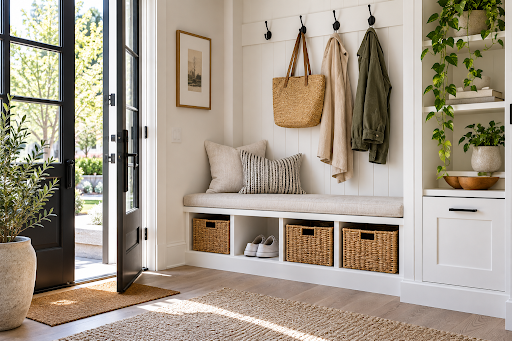
The entryway is a good example. Bags, jackets, shoes, keys, sunglasses, and mail all tend to arrive at the same place, yet many homes provide nowhere convenient to put them.
A narrow console, a row of hooks, a shallow shoe cabinet, a basket, or a storage bench can transform the area without occupying much floor space. In a particularly narrow hallway, wall-mounted solutions may work better than traditional furniture.
The same principle applies throughout the house. The closer storage is to the point where something is used, the more likely it is to remain organized.
A home becomes much easier to manage when belongings have obvious destinations rather than temporary resting places.
Be Selective About What Stays on Display
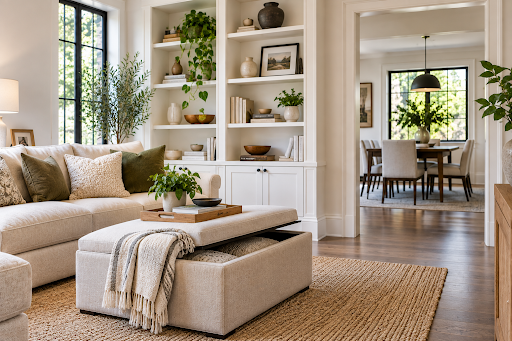 Open shelving has become a popular design feature, but it does not always make a room feel more spacious.
Beautiful ceramics, books, artwork, or a carefully edited collection can look wonderful on open shelves. Charging cables, household paperwork, cleaning products, spare batteries, and miscellaneous everyday items usually do not.
In rooms where visual clutter is already a problem, closed cabinetry can make an immediate difference. It allows the eye to rest and helps a room feel calmer even when the amount of stored material has not changed.
The goal is not to hide everything. A balanced interior usually combines display and storage. Attractive objects can remain visible while less decorative necessities live behind doors and inside drawers.
Sometimes the fastest way to make a room feel larger is simply to reduce the number of things competing for attention.
Make Furniture Work Harder
Furniture occupies some of the most valuable square footage in a home, which makes it worth asking whether each major piece is earning the space it takes up.
A storage bed can hold seasonal clothing or spare bedding. A bench can provide seating while concealing shoes or household supplies. An ottoman can offer both storage and an extra surface, while an extendable dining table can remain compact most of the week and expand only when necessary.
This does not mean every piece of furniture needs a hidden compartment.
The best multifunctional furniture solves a genuine problem without making the room more complicated. Replacing one bulky, single-purpose item with a more useful alternative can often recover more space than adding another cabinet or shelving unit.
The same thinking is especially useful in rooms that need to serve more than one purpose.
A guest bedroom may double as a home office. A dining area may become a homework station in the afternoon. A small corner of a bedroom may function as a workspace without taking over the room.
If a work area shares another space, furniture scale becomes particularly important. Our guide to choosing a comfortable home office chair without ruining the room explains how to balance comfort with proportion and design.
Look at the Space You Usually Ignore
Homes contain a surprising amount of unused space, but much of it is above or below normal eye level.
The area beneath a bed can accommodate drawers or appropriate storage boxes. Shelves placed higher in a closet can hold seasonal or rarely used items. Space beneath stairs may be suitable for built-in storage, while walls above existing furniture can sometimes accommodate cabinetry or shelving.
Closets in particular are often poorly used. A single hanging rod may leave a large amount of empty space underneath. Deep shelves can hide items behind one another, while upper areas may remain largely untouched.
Before buying another freestanding storage unit, it is worth improving the storage already built into the home.
Adding another hanging rod, shelf dividers, drawers, hooks, or properly sized containers can sometimes double the usefulness of an existing closet.
Vertical storage does require some care. The U.S. Consumer Product Safety Commission recommends anchoring potentially unstable furniture such as bookcases and dressers to reduce the risk of tip-over accidents. Its Anchor It! furniture safety guidance is a useful reference, especially for homes with children.
Heavy objects should generally remain lower down, while higher shelves are better suited to lightweight items that are not needed every day.
Rethink Kitchen and Laundry Storage
Kitchens often feel short on space even when they contain plenty of cabinets.
The problem is frequently not the number of cabinets, but what happens inside them.
Deep lower cabinets can become difficult to use because items disappear toward the back. Baking sheets and cutting boards take up less space when stored vertically. Drawer organizers can reduce the amount of countertop clutter, while pullout systems can make awkward corners easier to access.
The laundry room often has similar unused potential.
The space above a washer and dryer may accommodate shelves or cabinets. A narrow wall can hold hooks or a drying rail, and baskets can keep laundry supplies grouped together rather than scattered across countertops.
The most frequently used items should remain easiest to reach. Bulk refills, seasonal products, and occasional-use equipment can usually be stored higher up or farther away.
Good storage is not only about fitting more into a room. It is about reducing the amount of moving, stacking, and searching required to use the room every day.
Let Light Do Some of the Work
Lighting cannot create additional square footage, but it can dramatically influence how spacious a room feels.
Heavy furniture positioned in front of windows, oversized window treatments, or dark corners can make even a fairly large room feel compressed.
Natural light should be allowed to travel as freely as possible. The U.S. Department of Energy notes that thoughtful use of windows and skylights for natural light and daylighting can help brighten interiors while reducing reliance on artificial lighting during the day.
At night, a combination of ambient, task, and accent lighting can help define different areas of a room without making the entire space feel flat or dim.
Mirrors can also help distribute light, particularly in hallways, bedrooms, and smaller living areas. They do not create space, of course, but used thoughtfully they can make a room feel less enclosed.
Lighting works best after the larger storage and furniture problems have been addressed. Once visual clutter is reduced, better light allows that extra breathing room to be noticed.
Know When Some Things Should Leave the House
Organization can only accomplish so much.
Sometimes the most effective way to create more space in your home is to remove belongings that no longer need to occupy valuable space inside it.
Seasonal equipment, renovation materials, moving boxes, and temporarily displaced furniture may have legitimate reasons to be stored elsewhere for a period of time.
Portable or off-site storage can be useful during a move or renovation, but it works best when there is a clear plan for what is being stored and for how long.
Our guide to portable storage container ideas for moving, renovating, and reclaiming space looks at situations where temporary storage can genuinely make a project easier.
For everyday clutter, however, paying for additional storage should not become an excuse to postpone decisions indefinitely.
Some belongings may simply no longer deserve space in the home.
The Your Home Design Center Take
Creating more space in your home is less about discovering clever storage tricks and more about understanding how your rooms are actually being used.
When clutter continually appears in the same place, there is usually a reason. When a closet never seems large enough, its layout may be part of the problem. When a room feels cramped, oversized furniture or too many visible objects may be contributing just as much as the room’s dimensions.
The most successful homes are not necessarily the ones with the greatest square footage or the most storage.
They are the ones where the available space supports everyday life rather than constantly competing with it

Really good points you made here.