


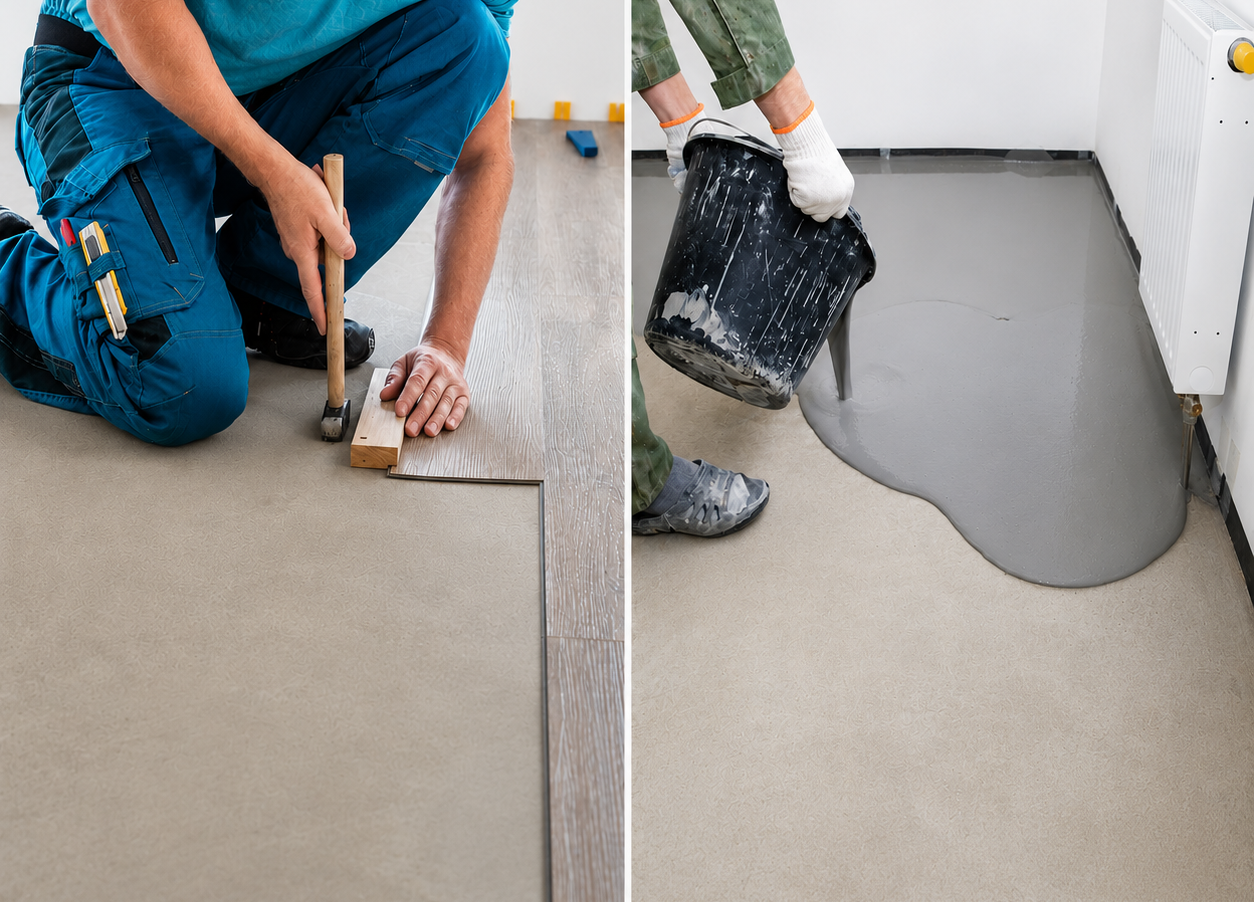
You’ve pulled up the old carpet. The subfloors underneath is a mess, like a dip near the doorway, a ridge along one wall, and an area in the middle that just doesn’t feel right underfoot. Now comes the decision most homeowners face and most installation guides gloss over: do you fix the floor first with a self-leveling compound, or just choose a floating floor and let it bridge the imperfections?
Both approaches are recommended online. Both have real merit. But they’re not interchangeable, and using one when the situation calls for the other is how you end up with squeaky boards, cracked joints, and a flooring warranty that’s already void.
This guide breaks down exactly when each approach works, what it won’t handle, and how to make the right call for your specific subfloor.
What “Uneven” Actually Means — and Why the Number Matters
The flooring industry measures subfloor flatness against a consistent benchmark: no more than 3/16 of an inch of variance over a 10-foot span, per ASTM Standard F-710. That’s the widely accepted threshold across most major flooring manufacturers for hard surface installations.
To check it yourself, lay a long straightedge or 10-foot 2×4 flat across the floor. Any gap you can slide your finger under is worth measuring. A small shim works fine. If the gap is approaching or exceeding 3/16″, you’re past what most floating installations can handle cleanly.
It’s also worth separating two different problems. Localized dips and humps, sunken spots under a doorway, and a raised area from an old patch job are point defects. A gradual slope or structural settlement is something else entirely. Self-leveling compound handles the first type well. It doesn’t fix the second, and that distinction matters a lot before you pick up a bag of compound.
Self-Leveling Compound: What It Actually Does
Self-leveling compound (sometimes called self-leveling underlayment or SLC) is a cement-based or gypsum-based product that, when mixed with water to a pourable consistency, flows across a subfloor and settles flat under its own weight. You don’t trowel it but pour, spread lightly with a gauge rake, and let gravity finish the work.
It’s effective for:
- Concrete subfloors with localized low spots, dips, or uneven patches
- Thin inconsistencies in the 1/4″ to 1″ depth range
- Situations where a hard surface floor (tile, hardwood, vinyl) will be glued or nailed directly over the top
Where it delivers genuine value is in giving you a clean, blank slate. Once cured, you’re not compromising your flooring choice based on subfloor conditions. Any product can go on top, such as tile, rigid-core LVP, or hardwood, because the surface is genuinely flat.
The practical limitations are worth knowing, too. You typically have a working window of just 15 to 30 minutes from the time you mix the compound to the time it starts setting. In larger rooms, that means moving fast and ideally having an extra set of hands. Most standard products are also designed for layers between 1/4″ and 1.5″ in a single pour because deeper corrections need a second application once the first has cured, not a single thick pour, which tends to crack.
It also requires solid subfloor prep, like a primer coat on concrete and on wood subfloors, and proper sealing to prevent moisture from disrupting the cure. Skip either step, and you’re looking at delamination or cracking down the road.
Curing time before foot traffic runs 4 to 6 hours for most fast-setting products. But light traffic and actually being ready for flooring installation are different things, as most products need 24 to 72 hours before any floor covering goes down.
Cost-wise, expect to spend in the range of $4 to $6 per square foot, including material and labor, for a small bathroom or entryway that’s manageable. For a full-floor renovation, that number adds up, and it should factor into your planning.
One thing self-leveling compound can’t do: it won’t correct underlying structural problems. If your slab is settling or your joists are failing, SLC sits on top of the symptom without addressing the cause. Cracks and movement underneath will eventually telegraph through.
Floating Floors: Built-In Tolerance, But Not Unlimited
Floating floors such as laminate, luxury vinyl plank, and engineered hardwood don’t get glued or nailed to the subfloor. The planks click together and essentially float as one connected surface above the subfloor, usually over a thin foam underlayment. That installation method gives them some inherent forgiveness for minor subfloor imperfections.
The noticeable thing is minor.
Most floating floor manufacturers specify the same flatness standard: 3/16″ over 10 feet. Some luxury vinyl products, especially thinner flexible formats, drop that tolerance to 1/8″ over 6 feet. The flooring is doing a bit of bridging over small dips, but it isn’t defying physics. When the subfloor variation exceeds what the product can span, the planks flex, the locking joints take stress they weren’t designed for, and the result is squeaking, bouncing underfoot, and eventually joints that fail or crack.
The type of floating product matters significantly here. Rigid-core SPC vinyl handles minor unevenness better than standard laminate, which handles it better than thin click-lock engineered boards. Not every floating product handles unevenness the same way, so knowing which flooring options for uneven floors hold up better under real subfloor conditions helps you match the right product to your specific situation, especially if subfloor correction isn’t fully in your budget.
That said, floating floors don’t solve a bad subfloor; they just have a slightly wider margin of tolerance. If you’re past that margin, the flooring itself will let you know. Usually through sound, first. Then, through visible movement. Then, through a warranty claim that gets denied because the subfloor wasn’t within spec at installation.
Head-to-Head: Where Each One Wins
| Factor | Self-Leveling Compound | Floating Floor |
| Addresses root unevenness | Yes, permanently corrects dips | No, bridges minor variance only |
| Works on concrete | Yes, with primer | Yes, within tolerance |
| Works on a wood subfloor | Yes, with sealing | Yes |
| Opens up all flooring options | Yes, tile, glue-down, nail-down, floating | No, limits you to floating or floating-compatible products |
| Project timeline | Adds 1–3 days for cure time | No added cure time |
| Handles structural issues | No | No |
| Cost addition | $4–6/sq ft | None (if within tolerance) |
| Best for | Moderate to significant dips, pre-tile installs | Minor variations, renovation budgets |
The decision isn’t always binary. In many projects, you do both: apply SLC to areas that exceed tolerance, then install a floating floor on top once it’s cured. That’s a reasonable middle-ground approach when unevenness is isolated to a few problem spots rather than spread across the entire room.
Which Should You Choose?
A few questions make this decision clearer:
- How severe is the unevenness? Slide a straightedge across the floor. If the gap is consistently under 3/16″ and there are no sharp high spots, a quality floating floor, especially rigid-core LVP, can likely go straight down. Beyond that threshold, or if you’re seeing dips of 1/4″ or more, self-leveling compound is the more reliable path.
- What’s going on top? If you want tile, stone, glued hardwood, or any installation method other than floating, you need a flat subfloor regardless of how minor the unevenness seems. Those products have zero tolerance for subfloor movement, and SLC gives you the surface they need. Floating floors are more forgiving, but only within their stated spec.
- Is this concrete or wood? Self-leveling compound works well on both, but wood subfloors require proper sealing first. Otherwise, moisture from the compound wicks into the wood and causes problems. If the wood subfloor has soft spots, bounce, or structural damage, fix that before anything else. No compound fixes a failing structure.
- What’s your timeline? If you need the floor down fast, some fast-setting compounds are walkable within a few hours and ready for flooring within 24 hours. That’s not a long delay. But if you’re on a tight schedule and the unevenness is genuinely minor, a suitable floating product might make more practical sense.
- What’s your budget? SLC adds cost. That cost is often justified because it protects the flooring investment in the long term. Installing a $6/sq ft floating floor over a subfloor that’s 1/2″ out over 10 feet isn’t saving money but just moving the problem into the flooring itself.
The Bottom Line
Self-leveling compound and floating Subfloors aren’t really competing solutions. They operate at different stages of the same problem. SLC corrects the subfloor. A floating floor installs over it (or over a subfloor that’s already within tolerance without it).
If your subfloor is significantly uneven, SLC is the honest answer. If it’s within the industry flatness standard, the right floating floor can go down cleanly. And if you’re somewhere in between, as most real-world subfloors are, targeted leveling in the worst spots, followed by a suitable floating installation, is often exactly the right approach.
The subfloor doesn’t get easier to fix after the flooring is down. It’s almost always worth getting it right first.
