


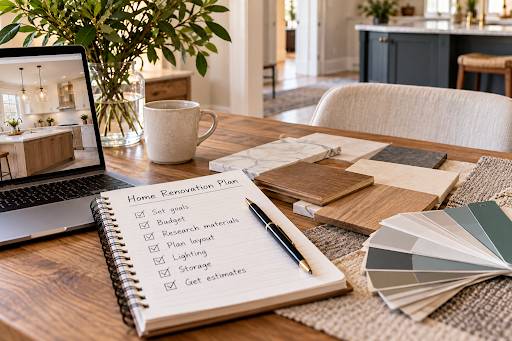
Renovating a home has a way of becoming more complicated than expected.
A plan to replace tired flooring can suddenly involve baseboards, paint, furniture, and a doorway that now looks strangely out of place. A simple kitchen update can uncover plumbing that needs attention. Even decisions that seem small at the beginning can affect the budget, schedule, and finished room.
The goal, however, is not to eliminate every surprise. It is to make better decisions before those surprises begin arriving.
The most useful home renovation tips are often less about choosing trendy materials and more about controlling the scope of the project, understanding how you actually use your home, and knowing which improvements deserve your money.
The Quick Answer
A smoother renovation usually starts with a few simple principles:
- Decide what problem the renovation needs to solve.
- Set the scope before demolition begins.
- Leave room in the budget for unexpected work.
- Clear the renovation area before contractors arrive.
- Research materials before making purchases.
- Reuse good-quality elements when replacement is unnecessary.
- Improve function before focusing on decoration.
- Plan lighting as part of the design.
- Use renovation work as an opportunity to address safety, comfort, and efficiency.
Here is how to put those ideas into practice.
1. Start With the Problem, Not the Pinterest Board
Before choosing tile, paint colors, or cabinet hardware, ask why the room needs renovating.
Perhaps the kitchen does not have enough usable counter space. Maybe the living room is dark even during the day. A bathroom may look dated, but its real problem could be inadequate storage.
Defining the problem first keeps the project focused.
Write down two lists: what currently frustrates you about the space and what you want the finished room to do better.
Knowing what you do not want is surprisingly helpful as well. If open shelving makes you nervous, there is little reason to install it because it happens to photograph well. If you dislike highly patterned tile, a trend should not convince you otherwise.
A renovated home should still feel like your home after the contractors leave.
2. Decide the Scope Before You Start Demolition
One of the easiest ways for a renovation to grow is through a series of seemingly reasonable additions.
If the flooring is being replaced, should the baseboards be changed too? If the cabinets are new, should the backsplash go? Once the backsplash changes, do the countertops suddenly look wrong?
This is how one room quietly becomes three projects.
Determine in advance what will be replaced, repaired, refinished, and left alone. If you are working with a contractor, get those decisions reflected in the written estimate or contract whenever possible.
Our guide to remodeling a house on a budget without cutting the wrong corners goes deeper into controlling project scope, comparing estimates, and protecting your renovation budget.
It is perfectly acceptable to change your mind during construction. Just understand that a change in one area can affect labor, materials, and scheduling elsewhere.
3. Clear the Space Before the Work Begins
Packing up a renovation zone sounds obvious, yet it is one of the easiest preparations to underestimate.
Remove furniture, artwork, lamps, electronics, books, and decorative objects rather than simply moving everything to the opposite side of the room. Contractors need space to move materials and equipment, and construction dust has an impressive ability to travel.
This is also a useful opportunity to decide what deserves to return when the project is finished.
If furniture or belongings need to be moved elsewhere temporarily, label boxes by room and keep frequently needed items accessible rather than burying them at the back of a garage or storage unit.
For larger projects, our guide to preparing your home for renovation covers decluttering, protecting belongings, and getting the household ready before work starts.
4. Research Materials Before You Fall in Love With Them
A beautiful material is not necessarily the right material.
That pale stone countertop may require more maintenance than your household wants to provide. A particular hardwood may look spectacular in a showroom but be less suitable for pets, wet shoes, or a busy entryway.
Before purchasing something because of appearance alone, investigate durability, maintenance, installation requirements, lead times, and replacement availability.
Samples matter too.
Look at paint, flooring, tile, fabric, and countertop samples inside your own home and at different times of day. Materials can look surprisingly different under morning sunlight, warm lamps, and bright kitchen lighting.
Research also gives you alternatives. Sometimes a less expensive material can provide the appearance or performance you wanted without consuming a disproportionate part of the budget.
5. Do Not Replace Something Just Because You Can
 Renovation does not have to mean starting over.
Solid cabinets may simply need new hardware or refinishing. Good hardwood flooring may be worth restoring. A well-made vanity can sometimes be updated with a new countertop, faucet, or paint finish.
Keeping existing elements can save money, but it can also make a home feel less like a collection of newly purchased parts.
The important distinction is between something that is cosmetically dated and something that is genuinely failing.
Water damage, unsafe wiring, deteriorated plumbing, and structural problems deserve attention before decorative upgrades. A scratched cabinet door is another matter entirely.
If the goal is primarily to make an interior feel newer rather than rebuild it, YHDC’s guide to affordable ways to refresh your home without renovating offers several lower-commitment alternatives.
6. Improve the Kitchen Around How You Actually Cook
A kitchen renovation can quickly become focused on finishes, but function should come first.
Before enlarging or replacing an island, for example, consider circulation around it. More counter space is useful only when people can comfortably move through the kitchen.
Think about where food is prepared, where groceries are unloaded, where small appliances live, and where dishes are put away.
An existing island might benefit more from drawers, accessible outlets, seating, or better task lighting than from being replaced entirely.
The same principle applies to cabinets. A well-organized interior can sometimes solve a storage problem more effectively than simply adding more cabinetry.
Renovate around everyday routines rather than a showroom photograph.
7. Plan the Lighting Before the Walls Are Finished
Lighting should not be one of the final decisions in a renovation.
Once ceilings are closed and walls are painted, adding new wiring, switches, or fixtures can mean reopening work that was supposedly finished.
Think in layers.
A room generally benefits from a combination of overall illumination, task lighting, and softer accent lighting. Kitchens may need under-cabinet lights in addition to ceiling fixtures. A living room can feel much warmer when table and floor lamps reduce dependence on a single overhead light.
Natural light matters too. Before adding fixtures, consider whether window treatments, furniture placement, or darker finishes are unnecessarily reducing daylight.
Our guide to creating more natural light indoors explores ways to make interiors feel brighter and more comfortable.
Renovation can also be a good time to consider the home’s overall energy performance. The U.S. Department of Energy recommends beginning with a home energy evaluation to identify where energy is being lost and which improvements may have the greatest effect. Its guidance includes measures such as air sealing, insulation, efficient windows and doors, heating and cooling improvements, and energy-efficient lighting.
8. Look for Usable Space Before Adding More Space
More square footage is not always the answer.
Sometimes a room feels too small because the storage is poorly arranged, the furniture is oversized, or valuable areas are not being used effectively.
An awkward alcove may accommodate built-in storage. The area beneath a staircase may have potential. A deep lower cabinet can become much more useful with pull-out storage. An underused wall might support shallow shelving without reducing circulation.
Before considering an addition, ask whether the existing floor plan is being used efficiently.
YHDC’s guide to creating more space in your home without adding square footage offers additional ideas for improving storage, layout, and furniture placement within the footprint you already have.
Every square foot you can make more useful is a square foot you do not have to build.
9. Know When the Project Has Moved Beyond DIY
 Painting a bedroom and opening a wall are very different projects.
Older homes in particular deserve extra care. The U.S. Environmental Protection Agency warns that renovation, repair, or painting projects in pre-1978 homes that contain lead-based paint can create dangerous lead dust. The EPA recommends using lead-safe work practices and advises homeowners to consider hiring a lead-safe certified contractor for this type of work.
Renovations can also uncover moisture problems, unsafe electrical work, asbestos-containing materials, or structural issues that should not be treated as ordinary DIY projects.
When something appears questionable, stop and find out what you are dealing with before covering it with a new finish.
A successful renovation is not simply one that looks better. It should leave the home safer and more functional as well.
The Your Home Design Center Take
The best renovation is rarely the one that changes the most.
It is the one that solves the right problems.
Plan the scope before construction starts, research materials beyond their appearance, and spend money where it improves safety, durability, or everyday function. Preserve good elements when they still have life in them, and use the opportunity to make lighting, storage, and layout work harder.
Most importantly, do not renovate according to someone else’s idea of the perfect home.
The finished space should make daily life easier in yours.