


Brazil has the kind of coastline that makes the phrase “beach vacation” feel almost too simple.
Travel along the Atlantic and the scenery keeps changing. In one region, enormous dunes collect seasonal lagoons between folds of white sand. Elsewhere, volcanic islands rise from clear water filled with marine life. Continue south and the coast becomes inseparable from music, food, architecture, city life, rainforest, and surf culture.
That variety is the real reason to explore the best of Brazil’s coast. There is no single Brazilian beach experience, and trying to reduce the country to palm trees and pretty water misses most of what makes it interesting.
For travelers choosing where to spend their time, six coastal regions tell the story particularly well. They are not stops on one enormous itinerary. Brazil is far too large for that to be sensible. Think of them instead as six very different reasons to plan a trip to the sea.
Jericoacoara and Lençóis Maranhenses Rewrite the Beach Vacation
Start in northeastern Brazil and the usual rules of a beach trip begin disappearing almost immediately.
Jericoacoara, in Ceará, grew from a fishing village into one of the country’s best-known coastal escapes, but its surroundings remain the real attraction. Sandy streets give way to dunes, mangroves, and freshwater lagoons, while reliable winds have made the area particularly popular for kitesurfing and windsurfing.
Then there is Lençóis Maranhenses.
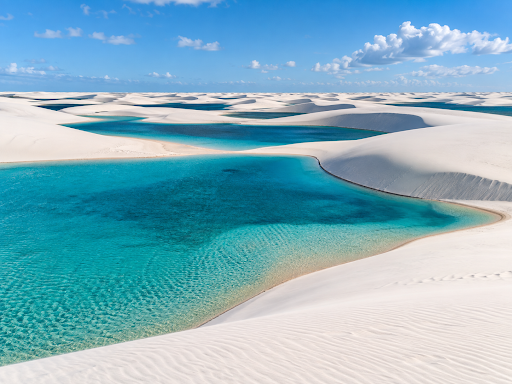
The landscape looks almost impossible from a distance: vast pale dunes interrupted by pools of rainwater. Unlike a true desert, the region receives enough seasonal rainfall to create temporary lagoons between the dunes. In 2024, UNESCO added Lençóis Maranhenses National Park to the World Heritage List, recognizing its exceptional natural landscape and the processes that continue to shape it.
This is the right stretch of coast for travelers who want movement rather than a resort chair: dune crossings, lagoons, wind, small settlements, and landscapes large enough to reset your sense of scale.
It also establishes something important early in the trip. Brazil’s coastline is going to keep changing.
Fernando de Noronha Makes Nature the Main Attraction
Fernando de Noronha is beautiful, but beauty alone is not why it belongs here.
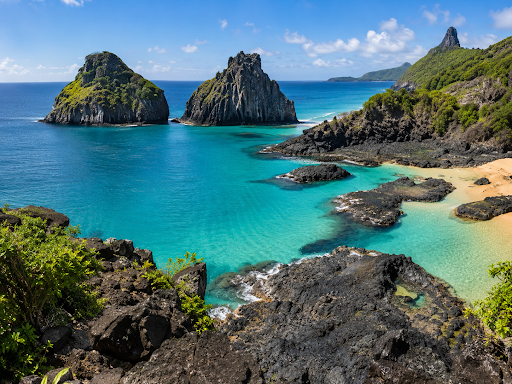
The archipelago off Pernambuco consists of 21 islands, and much of its terrestrial and marine environment is protected. Diving, snorkeling, surfing, hiking, and wildlife observation are central to the experience, with sea turtles, rays, dolphins, and other marine life sharing the water with visitors.
Baía do Sancho often receives much of the attention, while Cacimba do Padre attracts surfers and Baía dos Porcos offers another chance to experience the island from the water. But the most important difference between Noronha and many other tropical destinations is that conservation is not hidden behind the scenery. Visitor management, protected areas, and environmental rules are part of how the archipelago works. Travelers can review current destination information through Brazil’s official Visit Brasil guide to Fernando de Noronha.
That makes Noronha particularly appealing for travelers who want their beach time mixed with activity and a stronger connection to the natural environment.
A day here does not necessarily revolve around finding the perfect lounger. It might begin on a trail, move underwater with a mask and fins, and end at a viewpoint as the light changes across the Atlantic.
There are worse scheduling problems to have.
For readers especially drawn to underwater travel, YHDC’s guide to diving in Cozumel also explores why protected reefs, currents, marine life, and a little preparation can completely change the experience of a coastal destination.
In Bahia, the Beach Is Only Part of the Story
If Fernando de Noronha is defined by nature, Bahia reminds travelers that a coastline can be cultural as well as scenic.
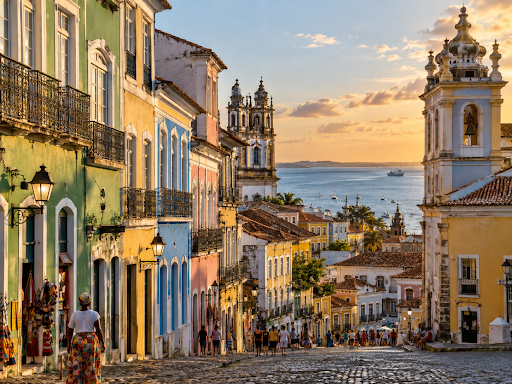
Salvador is the obvious place to understand why. Brazil’s first capital is one of the country’s great centers of Afro-Brazilian culture, expressed through music, religion, food, art, and daily life. The historic Pelourinho district adds architecture and history to the experience, while beaches such as Porto da Barra bring city life directly to the water.
Then the mood changes again farther south.
Trancoso has developed into one of Bahia’s best-known coastal retreats, but its identity extends beyond beach clubs and hotels. The Quadrado remains the center of town, framed by colorful buildings, restaurants, small shops, galleries, and its historic white church. Nearby Praia dos Coqueiros and Praia dos Nativos make it easy to move between village life and the coast without choosing one over the other.
 Continue through southern Bahia and the atmosphere can become quieter again. Smaller coastal communities, cacao-growing country, rivers, rainforest, and surf breaks begin to reshape the trip.
The combination is what makes Bahia deserve a place in this story. Beaches are part of the experience, but so are acarajé, moqueca, capoeira, music, architecture, craft, and history.
After several days in Bahia, the photographs may be full of ocean, but the memories probably will not be limited to it.
Readers comparing different kinds of seaside vacations can also explore YHDC’s guide to the best beaches to visit this summer, which shows how dramatically the experience around a shoreline can change the character of a beach trip.
Rio de Janeiro Makes the Coast Part of the City
Then there is Rio, where separating beach life from city life is almost impossible.
Copacabana and Ipanema are famous enough to require little introduction, but reducing Rio to two beaches ignores what makes its coastline extraordinary. Arpoador, Leblon, Leme, Guanabara Bay, Sugarloaf Mountain, and the forested hills all participate in the same visual composition.
UNESCO’s designation of Rio de Janeiro: Carioca Landscapes between the Mountain and the Sea recognizes precisely this relationship. The World Heritage property links the mountains of Tijuca National Park with the coastline and includes the designed landscapes along Copacabana Bay that helped shape Rio’s distinctive outdoor culture.
That is why Rio belongs in an article about Brazil’s coast even if a traveler never intends to spend an entire day lying on the sand.
Morning runners follow the waterfront. Surfers watch the conditions at Arpoador. Cafés, restaurants, neighborhoods, parks, and sports spill toward the sea. The beach functions almost like another public square.
Few major cities make the coastline feel so thoroughly woven into ordinary life.
For someone who wants museums, restaurants, nightlife, and city energy without surrendering access to the ocean, Rio provides something the more remote destinations in this guide simply cannot.
Paraty and Ilha Grande Put the Atlantic Forest at the Water’s Edge
After Rio’s urban energy, Paraty and Ilha Grande provide a particularly satisfying change of pace.
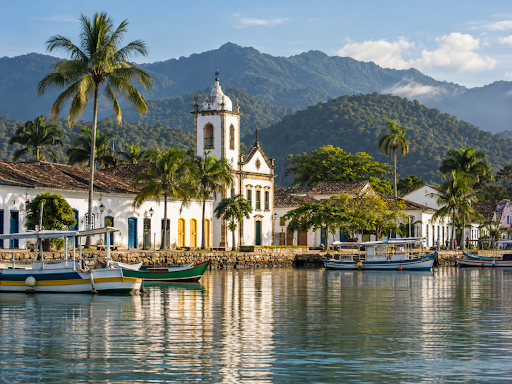
Paraty sits between forest-covered mountains and a sheltered bay, pairing preserved colonial architecture with a landscape of islands, beaches, and Atlantic Forest. Its historic streets are only part of the attraction; beyond town, the coastline opens into coves, islands, forest trails, and water best explored at a slower pace.
Paraty and Ilha Grande were jointly inscribed on the UNESCO World Heritage List in 2019 as a mixed cultural and natural property. The Paraty and Ilha Grande – Culture and Biodiversity designation encompasses Paraty’s historic center along with protected Atlantic Forest, the Serra da Bocaina landscape, islands, and coastal ecosystems.
It is hard to imagine a better match for the “hidden islands” part of this article’s title.
The pleasure here lies in moving between environments. Spend time on Paraty’s stone streets, then leave town by boat. Swim in a quiet cove. Explore an island. Hike through forest. Return for dinner as the light softens over the old buildings.
Ilha Grande pushes the nature side further. Forest, trails, beaches, and boat connections create a trip where the journey between places becomes part of the experience.
This stretch of Brazil’s coast is not about finding one perfect strip of sand and declaring the search complete. The landscape works because forest, mountains, history, islands, and water remain connected.
Florianópolis Shows a Different Side of Brazil
By the time the journey reaches Santa Catarina, Brazil’s coastline has changed personality again.
Florianópolis sits partly on the mainland and partly on Santa Catarina Island, surrounded by an unusually varied combination of beaches, dunes, lagoons, mangroves, hills, and Atlantic Forest. Surf destinations such as Joaquina and Praia Mole attract one kind of traveler, while calmer stretches offer an entirely different pace.
But the strongest reason to end here is that Florianópolis is more than a southern beach stop.
Food is an important part of the experience. Oyster cultivation is closely associated with the region, while Portuguese and Azorean influences remain visible in local architecture, fishing communities, and cuisine. Florianópolis is also part of UNESCO’s Creative Cities Network for gastronomy.
That opens up a very different day at the coast: surfing in the morning, exploring a fishing community in the afternoon, and sitting down to local seafood in the evening.
The climate changes, too. Unlike the more consistently tropical destinations farther north, southern Brazil has more defined seasons, with the warmer months drawing the strongest beach crowds.
It is a fitting final stop because it challenges whatever picture of Brazil the previous five destinations have created.
Apparently, the country was not finished changing the scenery.
Do Not Turn Brazil’s Coast Into One Giant Checklist
 Once these destinations are placed together, there is an obvious temptation to start drawing lines between them.
Resist it.
Brazil is enormous, and the six places in this guide work better as different trips to choose from than as boxes to check during one frantic vacation.
Jericoacoara and Lençóis Maranhenses make sense for travelers drawn to landscapes and adventure. Fernando de Noronha can easily justify a trip centered almost entirely on the archipelago. Bahia rewards travelers who want food, culture, and coastal life in the same experience. Rio suits those who want the sea without leaving the energy of a major city. Paraty and Ilha Grande naturally belong together, while Florianópolis can anchor a broader exploration of Santa Catarina.
Choosing fewer places also leaves room for the things that often become favorite memories: an unplanned lunch, another swim, a boat trip that lasts longer than expected, or an evening when nobody particularly wants to move on.
That philosophy applies well beyond Brazil. YHDC’s smart travel tips for young travelers make the same useful point: good planning should take care of the essentials while still leaving enough room for spontaneity once the trip begins.
When to Visit Brazil’s Coast Depends on Where You Are Going
 There is no useful single answer to the question, “When is the best time to visit Brazil’s beaches?”
The country covers too much ground.
Jericoacoara generally has a more distinct dry season during the second half of the year, while the appearance and depth of the lagoons at Lençóis Maranhenses depend heavily on seasonal rainfall. Fernando de Noronha remains warm through much of the year, but water and surf conditions change seasonally. Bahia follows another weather pattern, and Florianópolis has more pronounced seasonal differences than destinations farther north.
Conditions can matter more than temperature alone. Surfers, divers, wildlife watchers, and travelers hoping to see Lençóis Maranhenses with water-filled lagoons may all prefer different windows.
The sensible approach is to choose the coastal experience first and investigate its seasonal conditions second.
Brazil is simply too interesting for one weather rule.
The Your Home Design Center Take
The most memorable thing about Brazil’s coastline is not the number of beautiful beaches. It is how little one region prepares you for the next.
Start among dunes and rain-filled lagoons. Fly to an archipelago where marine conservation shapes the experience. Follow the coast to Bahia and find history, food, and Afro-Brazilian culture meeting the Atlantic. Reach Rio and watch the beach become part of city life. Continue to Paraty and Ilha Grande, where rainforest falls toward islands and sheltered coves. Finish in Florianópolis with surf, seafood, and an entirely different southern mood.
That is the best of Brazil’s coast.
Not one perfect beach. Not one enormous itinerary.
A collection of places different enough to make you want to come back and meet the rest.

super great options, never knew there are so many beautiful places in Brazil.
wow. I specifically like Jericoacoara, so authentic and lovely!