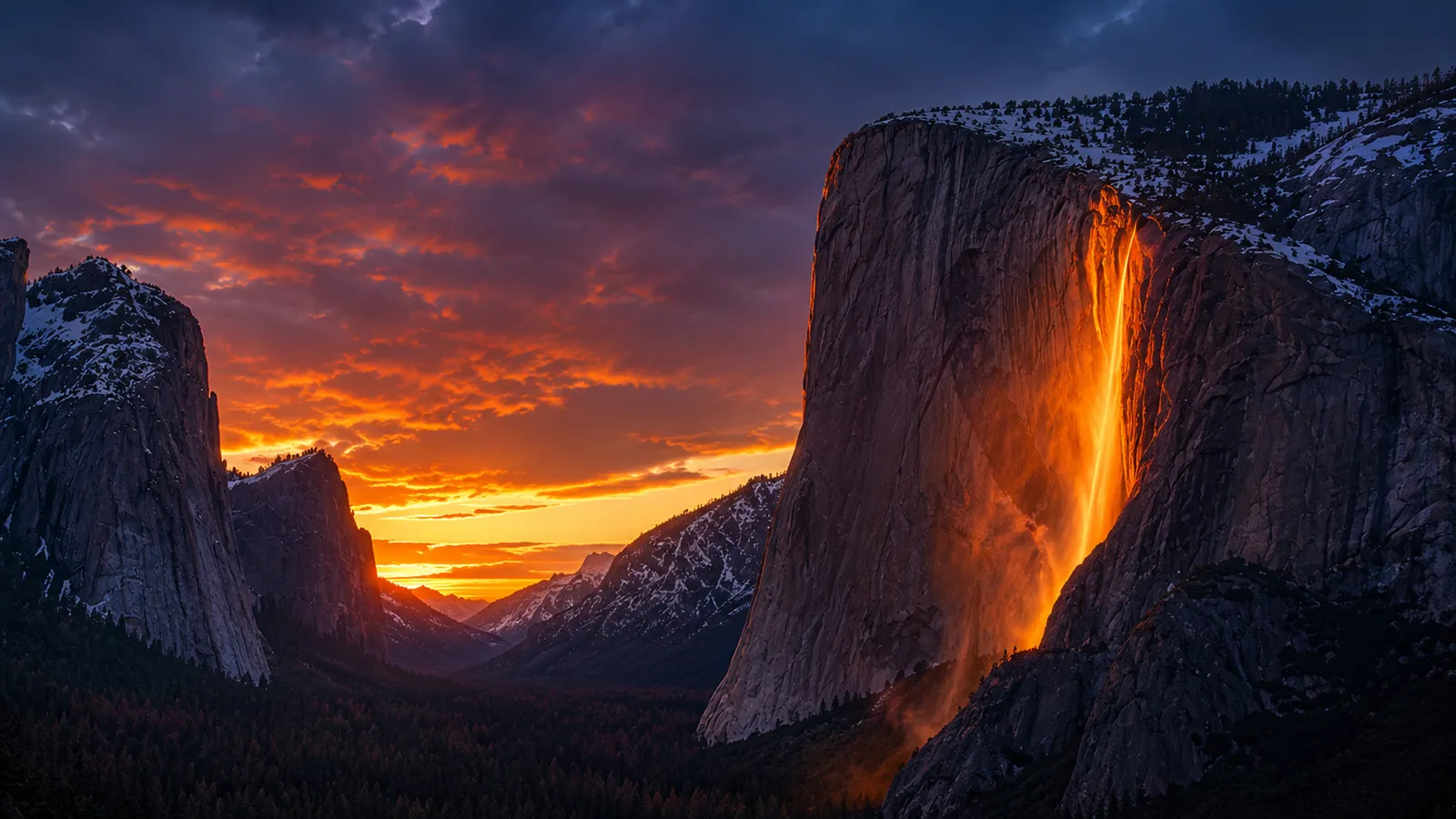
There are natural wonders that seem almost too perfectly staged to be real. Yosemite’s Firefall is one of them. For a few evenings each February, if water, weather and sunlight cooperate, a slender waterfall spilling from the eastern edge of El Capitan can suddenly glow brilliant gold and orange. From the valley floor, Horsetail Fall appears almost as though molten lava is pouring down Yosemite’s granite wall.
There are no special effects and, despite the nickname, no actual fire. The spectacle is created entirely by sunlight, flowing water and extraordinarily precise timing. That unpredictability is also part of what makes chasing Yosemite’s Firefall such an unforgettable winter adventure.
What Is Yosemite’s Firefall?
Horsetail Fall is a roughly 1,000-foot seasonal waterfall that flows over the eastern side of El Capitan. According to the National Park Service, it usually flows during winter and early spring, with the amount of water depending heavily on precipitation and snow conditions.
During a brief period in mid-to-late February, the setting sun can reach the waterfall at just the right angle. When the western sky is clear and Horsetail Fall is flowing strongly enough, the water may transform from silver to yellow, then gold and finally an intense orange-red against the darkening granite.

The phenomenon is often called Firefall, although Yosemite has another connection to that name. For decades, burning embers were once pushed from Glacier Point as a nighttime attraction. That human-created spectacle ended permanently in 1968. Today’s Horsetail Fall Firefall is entirely natural, considerably less predictable and arguably much more remarkable.
Why Seeing the Firefall Is Never Guaranteed
Planning a Firefall trip requires accepting one important fact: nature does not take reservations. Several things have to happen at the same time. Horsetail Fall needs sufficient water, the western horizon must remain clear, and the setting sun must hit the waterfall at precisely the right angle.
Even a thin layer of clouds or haze can diminish the effect or eliminate it completely. In 2026, Yosemite projected the primary viewing period from February 10 through February 26, but those dates were never a guarantee that the waterfall would glow every evening. Travelers coming from outside the area may want to plan several nights around Yosemite rather than betting the entire trip on a single sunset.
Getting to the Best Firefall Viewing Areas
Horsetail Fall is located on El Capitan in Yosemite Valley and is generally viewed from areas east of the waterfall. What sounds simple becomes more complicated when thousands of other people have exactly the same idea.
Firefall’s popularity has led Yosemite to use special parking, traffic and pedestrian-management measures during the February viewing period. In 2026, visitors did not need entrance reservations for Yosemite, a significant change from previous years. Instead, the park directed visitors toward designated parking, shuttle services and walking routes in Yosemite Valley.
Those arrangements can change from one year to the next, which is why older Firefall advice can quickly become unreliable. Before leaving home, check the National Park Service’s current Horsetail Fall information for that season’s viewing dates, parking restrictions, road conditions and entrance requirements.
Arrive Well Before Sunset
Firefall may happen around sunset, but arriving just before the sun goes down is not a realistic strategy. Parking can fill, valley traffic can become slow, and reaching a good viewing location may involve a considerable walk.
Arriving early also gives you time to enjoy Yosemite rather than treating the park as little more than a backdrop for one photograph. El Capitan, Yosemite Falls, Half Dome and the Merced River take on an entirely different personality during winter. The crowds are different from summer, the granite appears sharper in the cold air, and snow can turn familiar viewpoints into completely new landscapes.
Prepare for a Very Cold Evening
Photographs of people sitting beneath El Capitan waiting for the glow can make Firefall viewing look deceptively comfortable. It is still February in the Sierra Nevada.
Temperatures can fall rapidly after sunset, and snow or ice may be present. Dress in layers and bring gloves, a warm hat and footwear appropriate for winter conditions. A flashlight or headlamp is also useful for the walk back after sunset, when Yosemite Valley gets dark quickly.
If the trip includes a cabin or extended winter stay, our guide to staying warm and cozy during cold-weather travel has additional ideas for making a winter escape considerably more comfortable.
Photographing Yosemite’s Firefall
It is easy to understand why Firefall has become a magnet for photographers. A telephoto lens can isolate Horsetail Fall against the enormous face of El Capitan, creating the dramatic composition most people associate with the phenomenon. A tripod can also be useful as daylight begins to disappear.
But there is an argument for occasionally putting the camera down. When Firefall appears, the transformation can happen quickly. A waterfall that looked ordinary minutes earlier begins to warm, then seems to ignite before fading as the sun drops below the horizon. Take the photographs, certainly. Then give yourself a few moments to actually watch what you traveled all that way to see.
Make Yosemite the Destination, Not Just the Firefall
Building a longer Yosemite stay around Firefall gives you something valuable: options. If clouds spoil one evening, another sunset may work. If nature never cooperates, you still have one of America’s most extraordinary national parks outside your door.
Winter days can be spent exploring Yosemite Valley, viewing Yosemite Falls, walking accessible sections of the valley floor or simply taking in El Capitan without racing from one attraction to another. Road, trail and weather conditions can change quickly, so check official park conditions before heading out each day.
Where to Stay Near Yosemite

Staying close to Yosemite can make a Firefall trip substantially easier, particularly if you want to attempt more than one sunset. Lodging inside Yosemite Valley provides the shortest commute, although availability can be limited during popular periods.
Outside the park, travelers will also find lodges, cabins and resorts near Yosemite’s entrances. Rush Creek Lodge and its sister property Evergreen Lodge are among the established options near the Highway 120 entrance, offering a more retreat-like experience after a cold day in the park.
Wherever you stay, book early and understand the winter route between your lodging and Yosemite Valley. Mountain weather can change road conditions quickly, and tire-chain requirements may be in effect even when roads remain open.
Protect the Landscape You Came to See
Firefall’s popularity has not been without consequences. The National Park Service reported that more than 2,400 people gathered to view Horsetail Fall on February 19, 2022 alone. Heavy visitation has damaged vegetation, compacted soil and created problems along sensitive riverbank areas.
Stay in established or already disturbed viewing areas, respect fencing, use designated restrooms and take every piece of trash with you. Getting the perfect photograph is not worth damaging the landscape that created it.
Is Yosemite’s Firefall Worth the Trip?
Yes, but perhaps not for the reason social media suggests.
Seeing Horsetail Fall ignite against El Capitan can be spectacular, but chasing Firefall is also an exercise in accepting that travel does not always cooperate with an itinerary. You can choose the right week, arrive early, find the right viewing spot, bundle yourself in three layers and aim an expensive camera at the cliff.
Then the sky gets the final vote.
If everything aligns, those few glowing minutes can become one of the defining memories of a Yosemite trip. And if Firefall never appears? You are still standing beneath El Capitan in Yosemite Valley at sunset.
There are considerably worse ways to spend an evening.