


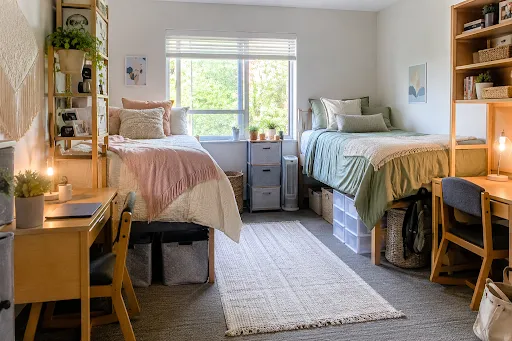
Moving into a college dorm is one of those experiences that sounds simple until you are standing in a small room with two beds, limited outlets, a narrow closet, and several boxes that suddenly seem much larger than they did at home.
A good dorm room does not need more stuff. It needs the right stuff in the right places.
Before buying bulky storage, appliances, rugs, or furniture, check your college’s residence-hall policies and room specifications. Rules for appliances, electrical equipment, wall decorations, bed configurations, and even what furniture can be moved vary by school. Knowing those restrictions before move-in can save money—and keep half your shopping haul from going straight back to the store.
Here are five college dorm room tips that make limited space easier to live in.
1. Know Your Measurements Before Buying Storage
Dorm-room organization starts with the space you actually have, not the room pictured on a retailer’s back-to-school page.
Check the dimensions of the bed, desk, closet, dresser, and available floor space before buying organizers. Many college beds can be raised or lofted, creating useful storage underneath, but schools may have specific rules about bed height or prohibit outside lofting equipment.
Under-bed clearance is especially important. Measure it at the bed height you are actually permitted to use before ordering large bins or drawer units.
The same goes for extra furniture. A storage ottoman may look useful online, but if it blocks the closet or leaves no room to pull out the desk chair, it has created a new problem rather than solving one.
Whenever possible, choose storage that fits spaces already available instead of adding another piece of furniture.
2. Make Vertical and Hidden Space Work Harder
When floor space is limited, look up and underneath.
Under-bed containers are ideal for extra bedding, seasonal clothing, shoes, towels, and supplies that do not need to be accessed constantly. In closets, slim hangers, shelf dividers, hanging organizers, and stackable bins can increase usable storage without changing the room itself.
Over-the-door organizers can also hold shoes, accessories, toiletries, snacks, or cleaning products—provided your residence hall allows them and they do not prevent the door from closing properly.
The goal is not to fill every available inch. Leave a little breathing room so new books, clothes, and everyday clutter have somewhere to go later in the semester.
For more temporary-space ideas, our guide to renter-friendly home improvements offers practical ways to make a space more functional without permanent changes.
3. Organize the Room Around Your Daily Routine
The best dorm organization solves problems you encounter every day.
Keep study supplies, chargers, headphones, notebooks, and pens close to the desk rather than spread throughout the room. Give backpacks, jackets, keys, and shoes predictable places so they do not migrate to the chair, bed, and eventually the floor.
Shared bathrooms require some extra planning. If the bathroom is across the hall rather than inside your room, a portable shower caddy, robe, shower shoes, and easy-to-carry toiletries are far more useful than a collection of countertop organizers.
Laundry should be equally portable. A hamper or laundry bag with sturdy handles is easier to carry down a hallway or several floors than a large rigid basket.
It also helps to decide where wet towels will dry and where frequently used toiletries will live between trips to the bathroom. Small decisions like these can make a compact room feel much less chaotic.
4. Add Personality Without Damaging the Room
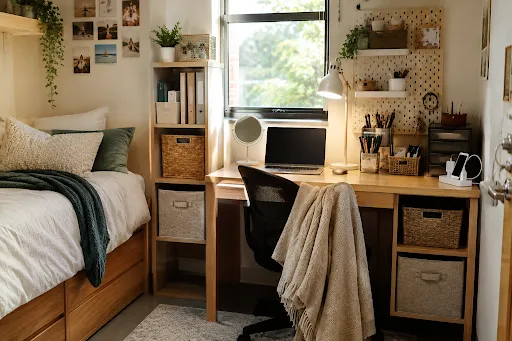
A dorm room should not feel like a blank box for an entire academic year, but decorating it comes with limits.
Many residence halls have rules about nails, screws, tape, adhesive hooks, removable wallpaper, tapestries, and other wall treatments. Check the specific policy for your building before attaching anything.
If permitted, photos, lightweight artwork, removable hooks, bedding, rugs, desk accessories, and freestanding decor can bring personality into the room without permanent alterations.
Lighting is another easy improvement. An approved desk or floor lamp can make a room feel warmer while providing better task lighting for studying.
You also do not need to decorate everything during move-in weekend. Bring a few familiar pieces first and allow the room to develop naturally. Our guide on how to make your new place feel like home has more ideas for adding comfort and personality to an unfamiliar space.
5. Be Smart About Outlets and Appliances
Dorm rooms may have fewer convenient outlets than the number of devices students want to plug in.
Laptops, phones, tablets, lamps, fans, gaming equipment, hair tools, and other electronics can quickly compete for the same outlets. The U.S. Consumer Product Safety Commission cautions against overloading outlets, extension cords, and power strips, while the National Fire Protection Association advises students to check their school’s rules before using electrical appliances.
That last point matters because appliance policies can be surprisingly specific. Do not assume a toaster, air fryer, hot plate, coffee maker, electric kettle, space heater, or other appliance is allowed simply because it is small.
Check first.
It is also worth coordinating larger permitted items with your roommate. There is little benefit in arriving with two mini refrigerators, two microwaves, and nowhere to put either person’s shoes.
What Should You Bring to a College Dorm Room?
A useful dorm packing list is easier to manage when it is organized by how the items will be used.
Bedding
- Correct-size sheets and pillowcases
- Mattress protector
- Comforter or duvet
- Pillows
- Extra blanket or mattress topper, if needed
Clothing
- Everyday and seasonal clothing
- Sleepwear and workout clothes
- Everyday shoes
- One interview or dressier outfit
- Slim hangers
Study Supplies
- Laptop or tablet and chargers
- Notebooks, folders, pens, and highlighters
- Headphones
- Backpack
- Desk lamp and planner
Bathroom Items
- Towels
- Shower caddy
- Shower shoes
- Robe
- Toiletries and grooming essentials
Laundry
- Portable hamper or laundry bag
- Laundry detergent
- Stain remover
- Mesh laundry bag if needed
Cleaning
- Multipurpose cleaner
- Microfiber cloths
- Trash bags
- Paper towels
- Small broom, dustpan, or permitted compact vacuum
Electronics
- Phone and laptop chargers
- Headphones
- Approved power strip, if permitted
- Desk or reading lamp
- Small fan, if allowed
Storage
- Properly measured under-bed containers
- Closet organizers
- Small bins or baskets
- Drawer organizers
- Over-the-door storage, if permitted
Before buying everything at once, compare this list with what the room already provides and what your roommate plans to bring. There is no prize for arriving on campus with the most storage bins.
Make the Room Work for You

A dorm room will never offer unlimited space, outlets, storage, or decorating freedom—and that is exactly why a little planning matters.
Check the rules before move-in, measure before buying, coordinate the bigger purchases with your roommate, and leave enough empty space to figure out what you actually need once college life begins.
The best dorm rooms are not the ones packed with the most products. They are the ones where you can study comfortably, find your things without a search party, and make a very small piece of campus feel unmistakably like your own.