



College days rarely happen in one place. A student may leave for an early lecture, cross campus for a lab, spend several hours in the library, grab lunch between classes, stop at the gym, and return to the dorm after dark. Somewhere along the way, a phone battery drops into the red, rain starts without warning, or the charger needed for a study session is sitting back in the room.
Useful college preparation is less about buying more and more about removing those small points of friction. The right college lifestyle essentials should make it easier to move through the day, study wherever there is an open table, keep basic routines under control, and leave for a weekend without packing from scratch.
The goal is not to own everything marketed to college students. It is to build a few reliable systems around the things students actually use.
Build a Backpack Around the Day You Actually Have
A campus backpack should match the schedule rather than the back-to-school display.
Look for padded shoulder straps, a protected laptop compartment, a secure water-bottle pocket, and enough space for a notebook, light layer, and lunch without turning the bag into luggage. Students who commute may also want an easy-access pocket for a student ID, keys, transit card, or earbuds.
Inside, a small zippered tech pouch can prevent cables, adapters, and earbuds from disappearing into different pockets.
A five-minute backpack reset each evening helps too. Remove wrappers and receipts, refill the water bottle, put chargers back in the tech pouch, and check what the next day’s classes actually require.
It is the same basic principle behind an organized home: frequently used things are much easier to manage when they have predictable places. YHDC explores that idea further in How an Organized Home Can Help You Reduce Stress.
Keep Everyday Tech Compact and Ready
Campus tech becomes frustrating when every device requires a separate accessory.
Along with the laptop or tablet already used for coursework, consider a compact power bank, one dependable charging cable, wall charger, and comfortable earbuds or headphones. Keeping the charging cable and power bank permanently in the everyday bag avoids the familiar problem of borrowing a charger midway through the afternoon.
The tech pouch matters here as much as the electronics themselves. Use it for charging cables, adapters, a flash drive if required for coursework, and other small accessories that would otherwise migrate between a desk, backpack, and jacket pocket.
Among the most useful college lifestyle essentials, the ones that reduce repeated little problems often earn their place more quickly than expensive gadgets.
Create a Study Setup That Works Beyond the Dorm
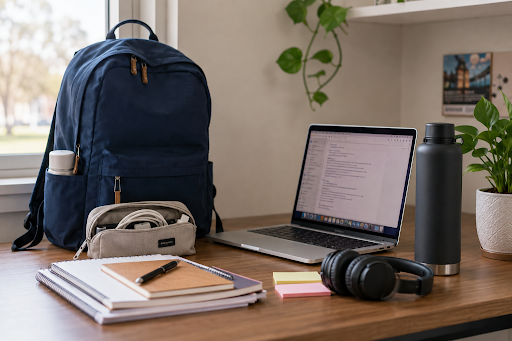
Students should be able to turn a library table, empty classroom, student center, or quiet café corner into a workable study area without hauling half their desk across campus.
A laptop or tablet, headphones, slim notebook, pen, and charger will cover most everyday sessions. A lightweight laptop stand may be useful for students who regularly work for several hours away from their rooms, but only if it is portable enough to be carried consistently.
Digital organization deserves attention too. Create folders by course, use sensible file names, keep important documents backed up, and download readings before heading somewhere with unreliable Wi-Fi.
The easier the setup is to repeat, the less time students spend getting ready to study instead of actually studying.
Make Hydration and Lunch Easy to Carry
A reusable insulated water bottle sounds obvious, but size matters. Choose one that fits the backpack’s bottle pocket and is comfortable enough to carry across campus all day.
For students who regularly bring meals, an insulated lunch tote is more practical than trying to balance several food containers inside a backpack. Add a washable snack container and reusable utensils for longer days.
For perishable lunches, food temperature matters. The USDA provides guidance on keeping packed lunches safe, including the use of insulated containers and appropriate cold sources.
Students do not need an elaborate meal-prep system. They simply need a realistic alternative when a ten-minute gap between classes is not enough time to find lunch.
Give Laundry a Repeatable Routine
Laundry gets considerably easier when the supplies travel together.
A soft-sided laundry bag with sturdy handles is easier to carry down hallways, staircases, or elevators than a rigid basket. Keep detergent, stain treatment, and a mesh bag for delicate items together rather than storing them in different parts of the room.
Choosing roughly the same laundry day each week can also prevent the familiar realization that the last clean T-shirt disappeared yesterday.
For advice specifically about arranging the room itself—including storage, layout, shared bathrooms, and limited space—see 5 Smart College Dorm Room Ideas for a More Organized, Comfortable Space. That companion article focuses on the dorm; this one focuses on the student’s everyday routine.
Prepare for Walking, Weather, and the Campus Commute
College often involves more walking than students expect.
Comfortable shoes should come first, followed by a few weather-related items appropriate for the campus climate. A compact umbrella that actually fits in the backpack, sunglasses, a packable rain jacket, and a light sweater for aggressively air-conditioned lecture halls can solve surprisingly frequent problems.
Students commuting by bicycle or e-scooter should also build safety into the routine. The U.S. Consumer Product Safety Commission advises riders to wear a bicycle helmet, follow local traffic laws, and inspect equipment for damage before riding.
A small personal-comfort pouch can hold things such as tissues, sunscreen, hand sanitizer, bandages, lip balm, or a stain-removal pen.
Pack for situations that happen regularly, not every emergency imaginable.
Make Weekend Travel Easier to Repeat
Trips home, conferences, away games, and weekends with friends become much easier when basic packing does not start from zero each time.
Keep a toiletry bag partly stocked with inexpensive duplicates of everyday items and leave a spare charging cable inside the travel bag. Packing cubes or zippered packing pouches make it easier to separate clothes, toiletries, electronics, and laundry.
Between semesters, students may face the larger question of what to do with bedding, clothing, small furniture, and other belongings. YHDC’s guide to smart portable storage container ideas includes practical approaches for temporary storage and moving.
The objective is not elaborate luggage organization. It is being able to leave for two nights without spending an hour looking for a toothbrush and charger.
Choose Dorm Conveniences by the Problem They Solve
A handful of room-based items belong in this lifestyle guide because students use them repeatedly as part of their routine.
For a shared bathroom, a draining shower caddy keeps shampoo, soap, grooming products, and other toiletries portable, while shower shoes make trips down the hall simpler. A clip-on reading light may help when roommates keep different schedules, and a permitted small fan can improve comfort in a warm room.
Before buying appliances, heating devices, or additional electrical equipment, students should check the rules for their specific residence hall. Policies vary by institution, and an item that cannot be used is not much of a convenience.
Waiting a week or two before buying nonessential extras is often sensible. Once classes begin, students quickly discover which inconveniences are recurring and which imagined move-in problems never materialize.
The Your Home Design Center Take
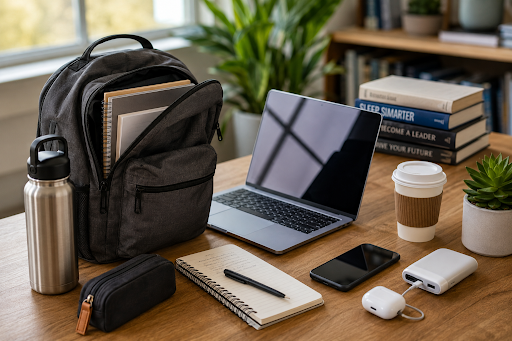
The most useful college lifestyle essentials eventually become almost invisible.
The compact power bank is charged. The tech pouch stays in the backpack. The laundry bag is easy to carry. Lunch remains simple to pack. The umbrella is there when the forecast changes. Packing cubes make a weekend trip quicker, and the shower caddy is ready without gathering toiletries every morning.
None of those things transforms college life on its own—and that is exactly the point.
A good campus setup should quietly remove unnecessary friction from ordinary days. When students know where their things are, can move easily between responsibilities, and have routines they can manage themselves, they spend less energy solving avoidable problems.
That growing ability to manage a schedule, belongings, meals, laundry, travel, and daily responsibilities is more valuable than arriving on campus with the longest shopping list. It is part of learning how to live independently.
