


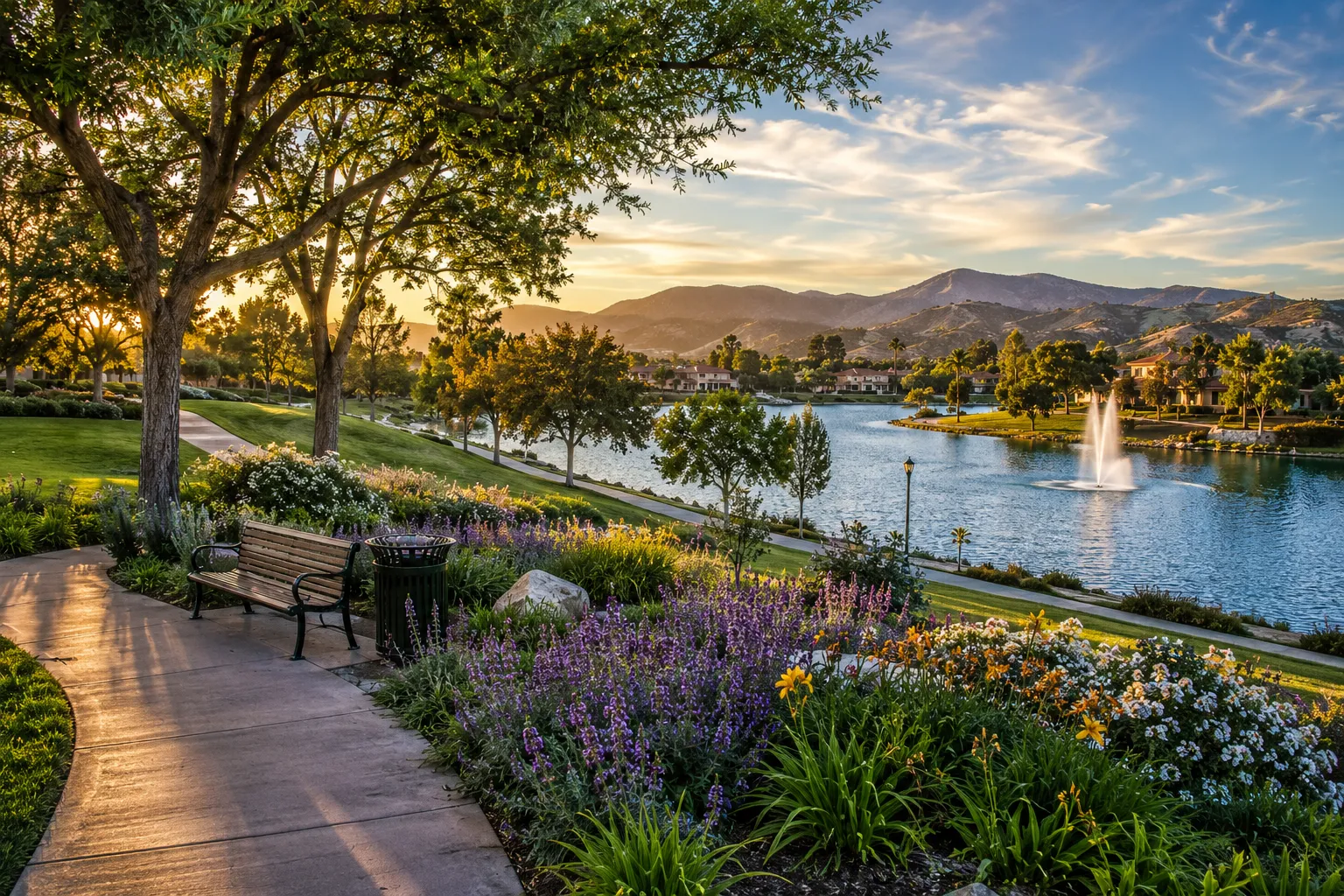
Mission Viejo may be best known for its hillside neighborhoods and lake-centered lifestyle, but some of the city’s most appealing features are considerably greener.
Parks, walking trails, mature trees, landscaped public spaces, and pockets of restored native vegetation are woven throughout the community. That makes Mission Viejo particularly interesting for homeowners looking for ideas they can borrow for their own yards.
You do not need 50 acres or a professional landscaping crew to take inspiration from a public park. The most useful ideas are often much simpler: creating shade where people actually sit, choosing plants that make sense for Southern California, giving pathways a purpose, and designing outdoor spaces that are attractive enough to draw people outside.
Mission Viejo offers plenty of examples.
Oso Viejo Park Proves Green Space Can Work Hard
At more than 50 acres, Oso Viejo Park is one of Mission Viejo’s substantial community green spaces. Sports fields, walking areas, fitness equipment, picnic facilities, playgrounds, and large stretches of landscaped grounds all have to coexist without making the park feel like one enormous paved recreation center.
That balance is what makes it interesting from a design perspective.
Different parts of the park serve different purposes, yet landscaping helps connect them visually. Trees provide shade and soften large recreational areas. Paths move people between spaces. Open lawn provides flexibility instead of being filled with permanent structures.
Homeowners can use the same principle on a much smaller scale.
A backyard does not need to perform one job. A dining area, garden, lawn, play area, and quiet seating corner can coexist if each space is clearly defined. Landscaping, pavers, changes in material, containers, or planting beds can create those divisions without building walls.
The result is an outdoor space that feels organized without becoming overly formal.
Oso Creek Trail Shows What Happens When Nature Becomes Part of the City
The 5.5-mile Oso Creek Trail system offers another side of Mission Viejo’s outdoor character. Portions of the creek edge have been replanted with vegetation associated with natural riparian streams, creating habitat used by wildlife as well as a recreational corridor through the city.
That makes the trail more than a place to walk. It demonstrates what happens when green infrastructure is allowed to function as habitat as well as scenery.
For homeowners, the takeaway is not that every backyard should be transformed into wilderness.
Instead, think about whether every plant in the yard needs to be purely decorative.
Plants can provide shade, attract pollinators, soften fences, create privacy, reduce glare, frame a view, or help make an otherwise forgotten corner of a property more useful.
If you are deciding what kind of garden makes sense for your property, our guide to 12 Types of Gardening and How to Choose the Right One explains the differences between container, raised-bed, native, pollinator, vegetable, herb, and other gardening styles.
Florence Joyner Olympiad Park Is Designed for Movement
Florence Joyner Olympiad Park combines green space with recreation in a way that feels particularly appropriate for a residential community.
The nearly 20-acre park includes sports fields, playgrounds, picnic facilities, and a walking trail. It also serves as a trailhead for the 3.1-mile paved loop around Lake Mission Viejo.
It is a useful example of an outdoor space designed around movement rather than appearance alone.
That distinction matters at home, too.
A beautiful backyard can still be frustrating if circulation was treated as an afterthought. People should not have to squeeze between furniture to reach the garden, walk through planting beds to get to a side gate, or drag a garden hose across the dining area every time plants need water.
Before adding another decorative feature, pay attention to how people actually move through the yard.
A well-placed walkway or series of stepping stones can sometimes improve an outdoor space more than another expensive piece of patio furniture.
Mission Viejo’s Landscape Is a Reminder to Design for the Climate
Southern California landscaping has changed considerably from the days when a large green lawn was treated as the default for almost every home.
Water availability, summer heat, maintenance costs, and changing design preferences have encouraged homeowners to consider more climate-appropriate landscapes.
Mission Viejo is served in part by Moulton Niguel Water District, which provides water and wastewater services in the area and offers guidance on water conservation and climate-appropriate landscaping.
That does not mean a Southern California garden has to look dry or barren.
Water-wise design can still include layers of foliage, flowering plants, shade trees, grasses, herbs, succulents, and dramatic architectural plants. The important part is choosing plants for the conditions rather than trying to force an entirely different climate into the yard.
Grouping plants with similar water needs also makes irrigation considerably easier to manage.
Native Plants Can Look Intentional Rather Than Wild
One reason some homeowners hesitate to use California native plants is the fear that the finished landscape will look messy.
It does not have to.
A native garden can look highly designed when plants are repeated, heights are layered, planting beds have defined edges, and hardscape provides enough structure to balance softer vegetation.
The same design principles used in traditional landscaping still apply.
Choose focal points. Repeat key plants. Mix foliage textures. Leave enough room for plants to reach mature size. And resist the temptation to buy one of everything at the nursery.
A garden generally looks more sophisticated when the plant palette has some discipline.
Native plants can also support local wildlife when properly matched to the site, which gives them a purpose beyond appearance.
Shade May Be the Most Valuable Feature in a Southern California Yard
Mission Viejo’s mature parks also make another point that is easy to appreciate during an Orange County summer: shade changes everything.
A patio can have beautiful furniture and expensive hardscape, but if it becomes unbearably hot every afternoon, nobody will use it.
Trees remain one of the most effective ways to create comfortable outdoor areas, although placement and mature size need careful consideration. Pergolas, umbrellas, covered patios, and other structures can supplement natural shade where trees are impractical.
The goal is not simply to make the yard look shaded in photographs. Think about where shade falls at the time of day you are most likely to use the space.
A dining table that receives shade at 9 a.m. but full sun at 6 p.m. may not be as well positioned as it initially appears.
Paths Make a Garden Feel Larger and More Intentional
Mission Viejo’s parks and trails demonstrate how strongly pathways influence the experience of an outdoor space.
A path tells you where to go, but it can also change what you notice along the way.
That same idea works in residential gardens.
A perfectly straight walkway creates a direct visual line and is appropriate when efficiency is important. A gently curving garden path slows the eye and can make a smaller landscape feel more layered.
Materials matter as well.
Concrete feels different from gravel. Large stepping stones create a different rhythm than brick or decomposed granite. The material should fit the architecture of the house as well as the amount of maintenance you are willing to accept.
The best path is not necessarily the most decorative one. It is the one people naturally use.
Edible Plants Do Not Need Their Own Ugly Corner
A well-planned green space can also produce something besides flowers.
Herbs, citrus, vegetables, and edible flowers can be incorporated directly into attractive residential landscaping rather than hidden in a purely functional vegetable patch.
Rosemary can become a structural shrub. Lavender provides color and fragrance. Citrus trees add glossy foliage as well as fruit. Herbs can fill containers near an outdoor kitchen or dining area where they are easy to use.
Raised beds can also become intentional design elements when their materials coordinate with the rest of the landscape.
If you are building or expanding a garden, our guide to building a garden tool kit without buying equipment you will never use can help keep the project from turning into an overflowing shed full of gadgets.
Green Space Does Not Have to Mean More Maintenance
One of the biggest mistakes homeowners make is creating a garden based on how it looks the day it is installed rather than how much work it will require six months later.
A heavily planted landscape can be beautiful, but every plant eventually needs something: irrigation, pruning, cleanup, feeding, pest management, or replacement.
Before adding another bed, hedge, or row of containers, consider how much time you realistically want to spend maintaining it.
Lower-maintenance landscaping often comes from better planning rather than having fewer plants.
Choose species suited to the site. Avoid plants that will quickly outgrow their location. Use irrigation appropriate to the planting. Leave enough space between mature plants. And make sure maintenance areas are easy to reach.
A garden that can be maintained comfortably is far more likely to remain attractive.
Borrow the Park Principle at Home
The best idea to take from Mission Viejo’s green spaces is not a particular plant, pathway, or park feature.
It is the idea that outdoor spaces should invite people to use them.
A beautiful garden that is only viewed through a window is missing an opportunity.
Add a bench beneath a tree. Create a small table for morning coffee. Position a chair where the late-afternoon light is pleasant. Give children somewhere to play without taking over the entire yard. Plant herbs close enough to the kitchen that somebody will actually pick them.
Landscape design works particularly well when appearance and daily life support each other.
Mission Viejo’s parks succeed because they are not simply green. They provide reasons to walk, sit, picnic, exercise, play, gather, and spend time outdoors.
Your backyard does not need to compete with a 50-acre community park. It only needs to give you a reason to step outside.