
They never chirp at 3 p.m., when the house is bright, everyone is awake, and someone can calmly find a fresh battery. They wait until 3 a.m., when the hallway feels longer than usual, the whole house is asleep, and no one can tell which little white circle on the ceiling has decided to ruin the night.
Chirp.
Silence.
Chirp.
Suddenly, everyone is awake. Someone is standing under one alarm, convinced it is the guilty one. Someone else swears the sound is coming from the kitchen. The dog is concerned. No one knows where the batteries are. And the smoke detector continues its tiny performance with the confidence of a device that knows it will win.
It is funny because it is familiar. But it is also a reminder.
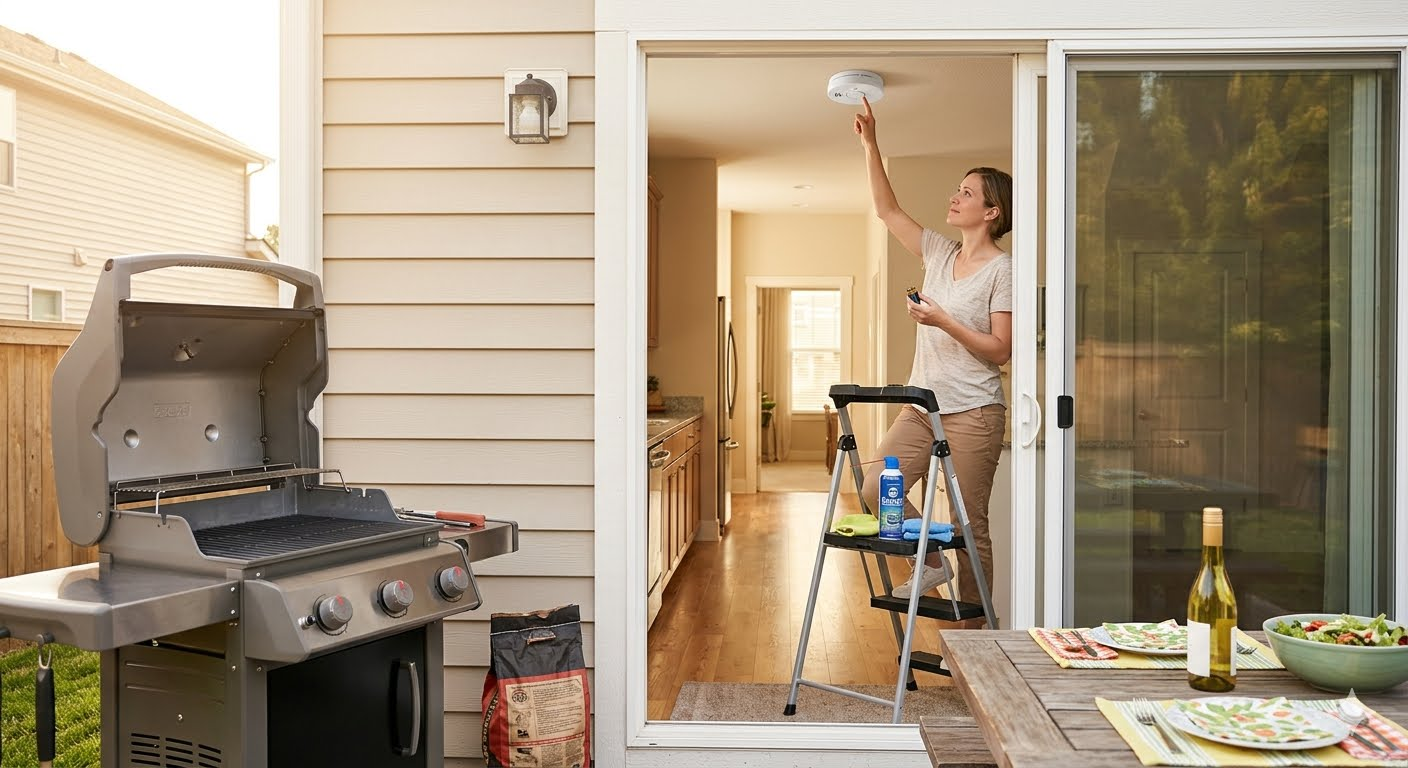
With summer cleaning tasks underway and BBQ season beginning, smoke detectors and carbon monoxide alarms deserve a place on the home prep list. We remember to scrub the grill, check the propane, rinse the patio furniture, refresh the outdoor cushions, and make the backyard look ready for guests. But the quiet safety devices inside the home are often ignored until they start chirping in protest.
Testing alarms, replacing weak batteries, checking placement, and looking for expired units may not make the house look cleaner. It will not give the patio a glow-up. It will not impress anyone arriving with a bottle of wine and a side dish.
But it can save lives.
Why Smoke Alarms Belong on Your Summer Cleaning Tasks List
Summer cleaning usually begins with the visible parts of the home. The windows get washed. The patio gets swept. The grill gets cleaned. Outdoor furniture comes out of storage. The house starts to feel lighter, brighter, and ready for the season.
But summer also changes how the home is used.
BBQ season brings more cooking, more guests, more open doors, and more movement between the kitchen and backyard. Someone may be grilling outside while someone else is warming sides in the oven. A guest may light a candle on the patio table. A fire pit may become part of the evening. Kids, pets, music, conversation, and distractions all become part of the atmosphere.
That is not a reason to make summer entertainment feel scary. It is a reason to make the home ready.
Smoke alarms are early-warning tools. Their job is not to prevent every emergency. Their job is to give people time: time to wake up, time to react, time to get outside, and time to call for help.
That is why this small task belongs in the summer cleaning routine. Not because it is glamorous, but because it protects the people gathered in the home.
Monthly Testing Should Be the Standard
A summer safety check is a smart reminder, especially before the grilling season gets busy. But smoke and carbon monoxide alarms should not be tested only once a year.
Monthly testing should be the standard.
The U.S. Fire Administration recommends testing smoke alarms every month and replacing smoke alarms that are more than 10 years old. It also recommends placing smoke alarms inside and outside bedrooms and sleeping areas, and on every level of the home.
That means the summer cleaning checklist should not be the only time these devices get attention. Instead, use it as a reset point. Walk through the home, test every alarm, replace weak batteries, check expiration dates, and then set a monthly reminder so the habit continues after BBQ season begins.
The test itself is simple. Press and hold the test button until the alarm sounds. The sound should be loud, clear, and strong. If the alarm is weak, delayed, silent, or unreliable, replace the battery or follow the manufacturer’s instructions for replacing the unit.
If an alarm does not respond properly, do not assume it is “probably fine.” A safety device that cannot pass a basic test needs attention.
Smoke Alarms, Carbon Monoxide Alarms, and Why You Need Both

A smoke alarm senses smoke particles in the air and alerts the home to a possible fire.
A carbon monoxide alarm senses carbon monoxide, a gas that cannot be seen, smelled, or tasted. Carbon monoxide can come from fuel-burning appliances, fireplaces, furnaces, water heaters, attached garages, gas stoves, generators, and other equipment.
During BBQ season, that distinction matters. Grills, generators, and fuel-burning equipment should never be used indoors, inside garages, or in enclosed spaces. Even when the cooking happens outside, carbon monoxide safety is part of responsible seasonal home care.
Many homes benefit from both smoke alarms and carbon monoxide alarms. For convenience, some products combine both functions in one unit. A First Alert combination smoke and carbon monoxide alarm is one example of this category, offering smoke and CO protection in one device for areas such as hallways, bedroom zones, or each level of the home.
Combination alarms can make maintenance easier, but they should not make homeowners careless. One device may detect two dangers, but it still needs to be tested, maintained, placed properly, and replaced when it expires.
Where Smoke and Carbon Monoxide Alarms Should Be Placed
Before comparing alarm types or replacing batteries, make sure the home has alarms in the right places.
Smoke alarms should generally be installed inside bedrooms, outside sleeping areas, and on every level of the home, including the basement. The National Fire Protection Association gives the same placement guidance and also notes that alarms should be installed on every level of the home.
Carbon monoxide alarms should be installed according to the manufacturer’s instructions and local codes. The U.S. Consumer Product Safety Commission recommends CO alarms on every level of the home and outside sleeping areas, and notes that interconnected CO alarms are best because when one sounds, they all sound.
Placement matters because alarms can only help when they are close enough to warn the household and installed where they can work properly. Bedrooms, hallways near sleeping areas, basements, and levels with fuel-burning appliances all deserve attention.
This is also where homeowners should be careful with kitchen-adjacent areas. It may seem logical to place an alarm as close to the kitchen as possible, but alarms installed too close to cooking appliances, steam, or normal cooking smoke can create nuisance alarms. Instead of guessing, follow the manufacturer’s placement instructions for the specific alarm.
The goal is not to avoid alarms near living spaces. The goal is to place them correctly.
A Simple Guide to Smoke Alarm Types
Most homeowners do not spend much time thinking about smoke alarm technology. They buy what is available, install it, and hope they never need it.
But not all smoke alarms work the same way. Some fires flame quickly. Others smolder first, producing smoke before visible flames appear. That is why the two most common smoke detection technologies, ionization and photoelectric, are worth understanding.
Ionization smoke alarms are generally more responsive to fast-flaming fires. These are fires that grow quickly and produce flames rapidly.
Photoelectric smoke alarms are generally more responsive to smoldering fires. These fires may begin quietly, producing smoke before large flames appear. Upholstery, bedding, mattresses, curtains, and wiring can all be part of that slower, smokier risk.
Dual-sensor smoke alarms include both ionization and photoelectric technology in one unit. That means one alarm is designed to respond to both fast-flaming fires and slower, smoldering fires. For many homeowners, this can simplify the decision.
Still, alarm type should not replace proper placement. For kitchen-adjacent rooms or hallways near cooking areas, follow the manufacturer’s instructions carefully. The right distance from cooking appliances can help reduce nuisance alarms while still keeping important protection in place.
Kidde smoke alarms include models across battery-powered, hardwired, and 10-year sealed battery categories, which can help homeowners choose based on the way a room is used. The important thing is to choose a reliable alarm, install it correctly, and test it regularly.
The simplest takeaway is this: the best smoke alarm is not just the one that beeps the loudest. It is the one that fits the space, is placed properly, and gets checked every month.
Newer Features That Make Alarms Easier to Manage
Smoke and carbon monoxide alarms have become more useful and less mysterious than the basic ceiling alarms many of us grew up with.
Some newer alarms come with sealed 10-year batteries. These batteries are built into the unit and are not designed to be replaced each year. Instead, the entire alarm is replaced at the end of its service life or according to the manufacturer’s instructions. For anyone haunted by the low-battery chirp, that can be appealing.
Voice alerts are another helpful feature. Instead of only beeping, some alarms can announce whether the issue is smoke, carbon monoxide, or a low battery. That can reduce confusion, especially when everyone is half-asleep.
Smart alarms add another layer of convenience. These devices may send alerts to a phone, identify the type of danger, or connect with other alarms in the home. The First Alert SC5 Smart Smoke & Carbon Monoxide Alarm is one example of a newer smart option with app alerts, voice alerts, and low-battery notifications.
Interconnected alarms are also worth considering, especially in larger homes or homes with multiple levels. When one alarm sounds, all connected alarms sound. That means smoke or carbon monoxide detected in one part of the house can trigger warnings in bedrooms, hallways, and other areas where the original alarm may not be heard.
These features can make home safety easier to manage. They do not, however, make alarms maintenance-free. A smart alarm still needs to be tested. A sealed-battery alarm still has an expiration date. A hardwired alarm may still have a backup battery.
Technology helps, but the habit matters more.
How to Test Batteries and Replace Old Units
Testing alarms is simple, which is exactly why it is easy to postpone.
Start by walking through the home and finding every smoke alarm and carbon monoxide alarm. Check bedrooms, hallways, common areas, basements, and each level of the home. Press and hold the test button on each unit until the alarm sounds.
If the alarm is loud and clear, move to the next one.
If the alarm is weak, delayed, or silent, replace the battery or follow the manufacturer’s instructions for replacing the unit.
For alarms with replaceable batteries, open the battery compartment, remove the old battery, and insert a fresh battery of the correct type. Close the compartment securely, reinstall the alarm, and press the test button again.
Do not use mystery batteries from a drawer. Use fresh batteries.
Hardwired alarms should also be tested because many have backup batteries. If a hardwired alarm starts chirping, the backup battery may need to be replaced.
For sealed 10-year alarms, the battery usually cannot be replaced. If the alarm gives an end-of-life warning, fails a test, or has reached its expiration date, replace the entire unit.
This is also the moment to check the age of each smoke alarm. Twist the alarm off the ceiling or wall bracket and look at the back. Most units have a manufacture date printed on the label. If the date is more than 10 years old, replace the alarm. If the label is missing, faded, or unreadable, it is safer to replace the unit.
A smoke alarm can look perfectly fine from the outside and still be too old to trust. The sensors inside age quietly, which is why old alarms should not stay on the ceiling forever just because they still make noise when tested.
Do Not Forget Carbon Monoxide Safety During BBQ Season

Carbon monoxide safety is not only a winter concern.
Summer can bring its own risks because people are using grills, generators, outdoor cooking equipment, fire pits, and fuel-burning appliances in different ways. A grill should stay outside and away from enclosed spaces. A generator should never be used inside a garage, basement, shed, or near open windows. Fuel-burning appliances should be maintained properly and used according to instructions.
Carbon monoxide alarms are especially important near sleeping areas because CO can be dangerous before anyone realizes something is wrong. Since carbon monoxide cannot be seen or smelled, the alarm is often the first warning.
This is also why manufacturer instructions matter. Carbon monoxide alarms should not be placed randomly. They should be installed where the manufacturer recommends, in line with local codes, and in locations where furniture, curtains, vents, or appliances will not interfere with performance.
A good summer safety check should include both smoke and carbon monoxide protection. Fire safety and CO safety are different, but both belong in a prepared home.
A Small Summer Check With a Big Purpose
Summer cleaning tasks is usually about making the home feel ready for the season people can see.
The patio gets refreshed. The grill gets cleaned. The table is set. The outdoor lights come on. Maybe there is a fire pit, a dining area, or a new seating arrangement inspired by patio design ideas that make outdoor living feel more comfortable.
But the best homes are not only clean and welcoming. They are prepared.
Testing smoke alarms will not transform the backyard. Replacing a battery will not get compliments from guests. Checking the manufacture date on an old alarm will not make a great summer photo.
Still, it belongs in the ritual of getting a home ready for the season.
Before the first big BBQ, walk through the house. Test every smoke and carbon monoxide alarm. Replace weak batteries. Check the age of each unit. Confirm that smoke alarms are installed inside bedrooms, outside sleeping areas, and on every level of the home. Make sure carbon monoxide alarms follow manufacturer instructions and local codes, especially near sleeping areas and in homes with fuel-burning appliances.
Then set a monthly reminder so this does not become another task that waits until next summer.
After that, go back to the good parts of the season: the grill warming up, the patio filling with conversation, and the easy comfort of knowing the home is ready for the people inside it.
And with a little luck, the only thing interrupting the house at 3 a.m. will not be a smoke alarm asking why you ignored it all spring.
Here are some other articles related to your search:
- Best Vacuum Cleaners for a Cleaner, Easier Home
- 15 Essential Cleaning Products Every Home Should Have
- Best Vacuum Cleaners for a Cleaner, Easier Home
- Top tips to clean leather furniture