


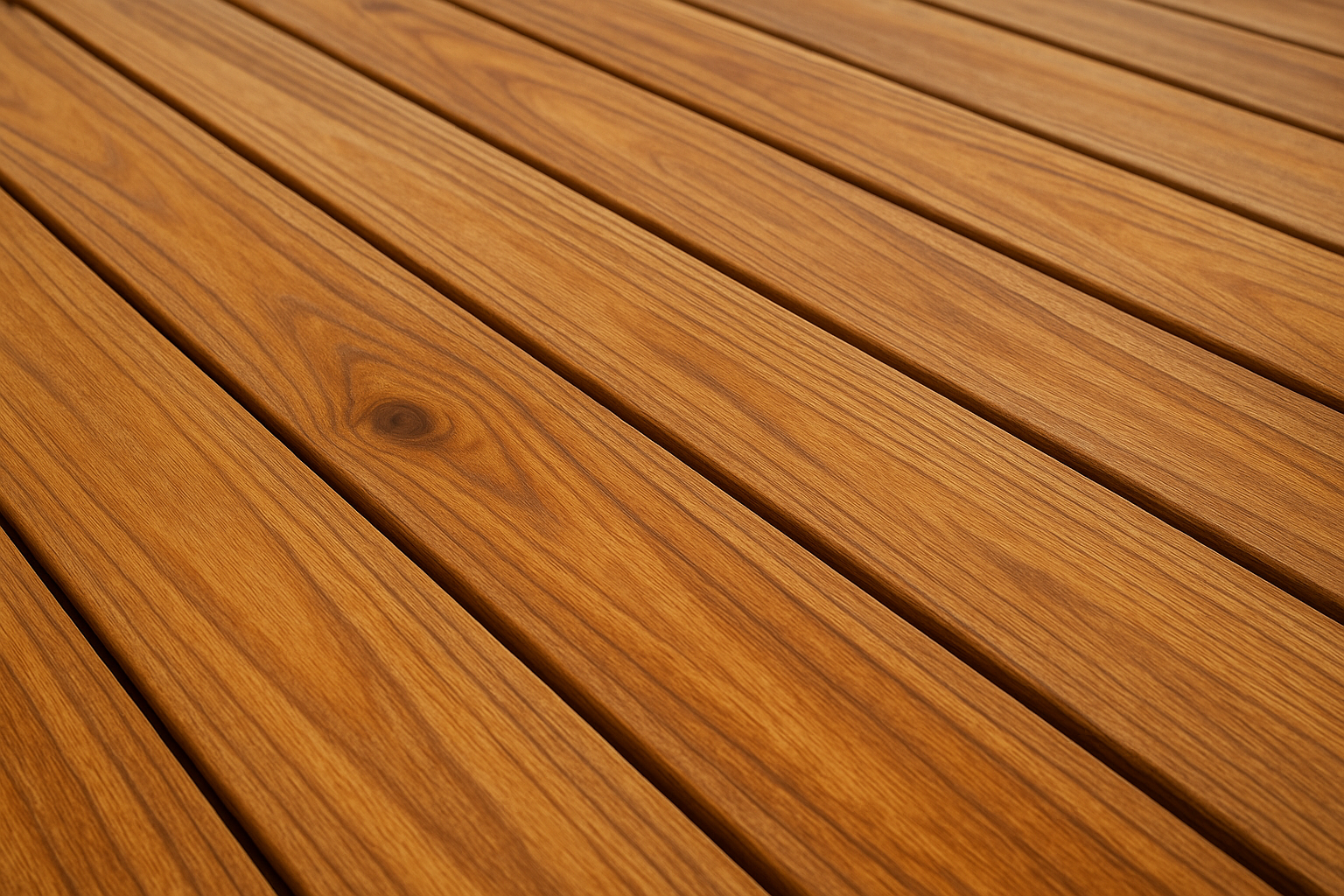
Choosing the right wood for decking is not just a matter of aesthetics—it directly impacts durability, maintenance, and long-term cost. In outdoor environments exposed to UV, moisture, and temperature variations, the wrong species can deteriorate quickly.
Acacia and teak are both premium hardwoods, but teak remains the benchmark for longevity and stability, while acacia stands out as a cost-effective and visually appealing alternative for well-maintained projects.
Understanding decking performance: what really matters
Before comparing species, it’s essential to define what makes a good wood for decking. Professionals typically evaluate four key criteria:
- Durability class (natural resistance to decay and insects)
- Dimensional stability (resistance to warping and cracking)
- Density (linked to hardness and wear resistance)
- Maintenance requirements
According to European durability classifications (EN 350), both teak and acacia fall into high-performance categories, but their behavior over time differs significantly.
Teak: the benchmark for outdoor durability
Teak (Tectona grandis) has been used for decades in marine and exterior applications. Its reputation is not accidental—it is one of the most stable and durable hardwoods available.
- Durability class: Class 1 (very durable)
- Density: ~650–750 kg/m³
- Natural oils: high content, acts as built-in protection
- Lifespan: 25–50 years outdoors without structural degradation
The high oil content protects teak from moisture, fungi, and insects. It also limits cracking and deformation, even in extreme climates.
Over time, teak develops a uniform silver-grey patina if left untreated—a sought-after aesthetic in many architectural projects.
Acacia: an accessible hardwood with strong visual appeal
Acacia (often Acacia mangium or Robinia pseudoacacia in Europe) is increasingly used in residential decking due to its affordability and warm tones.
- Durability class: Class 1–2 (durable to very durable depending on species)
- Density: ~700–850 kg/m³
- Color: golden to reddish brown
- Lifespan: 10–25 years with proper maintenance
Acacia is harder than teak, which makes it resistant to impacts and scratches. However, it is also more reactive to humidity variations, which can lead to movement if not properly installed.
For homeowners looking for a balance between performance and budget, acacia decking boards can offer a visually rich and structurally sound solution when sourced and installed correctly.
Stability and behavior over time
This is where the gap between the two woods becomes clearer.
Teak:
- Minimal shrinkage and expansion
- Very low risk of cracking
- Stable even without treatment
Acacia:
- Higher movement rate
- Requires careful installation (ventilation, spacing)
- More sensitive to moisture cycles
In practice, this means teak is more forgiving in complex environments (coastal areas, poolsides), while acacia demands stricter installation standards.
Maintenance: what to expect in real conditions
Both woods can be left untreated, but their aging process differs.
Teak:
- Can be left natural (silver-grey patina)
- Optional oiling to maintain original color
- Low maintenance overall
Acacia:
- Requires regular oiling (1–2 times per year)
- More prone to surface cracks if neglected
- Color fades faster without protection
Maintenance is often underestimated in decking projects. Over 10 years, upkeep costs can significantly impact the total investment.
Cost comparison: short-term vs long-term value
Initial pricing is often the deciding factor.
- Acacia: €40–€80/m²
- Teak: €120–€250/m²
However, when factoring lifespan and maintenance:
- Teak offers lower lifecycle cost despite higher upfront price
- Acacia remains attractive for medium-term projects or budget constraints
This distinction is critical for architects and contractors working on long-term outdoor installations.
Environmental considerations
Sourcing plays a major role in sustainability.
- Teak: must be FSC-certified or plantation-grown to avoid deforestation issues
- Acacia: often fast-growing and more widely available from sustainable sources
From an environmental standpoint, responsibly sourced acacia can be a strong alternative when teak traceability is uncertain.
Quick decision guide
- Choose teak if:
- You want maximum durability
- Maintenance must be minimal
- The project is high-end or long-term
- Choose acacia if:
- Budget is a constraint
- You accept regular maintenance
- The project is residential or mid-term
Questions fréquentes
Is teak always better than acacia for decking?
Short answer: Yes for durability, not always for budget.
Details: Teak outperforms acacia in lifespan and stability, but acacia remains a viable option for cost-conscious projects.
Does acacia wood crack easily outdoors?
Short answer: It can if poorly maintained.
Details: Proper installation and regular oiling significantly reduce the risk of cracking.
Which wood requires less maintenance?
Short answer: Teak.
Details: Thanks to its natural oils, teak can be left untreated with minimal impact on performance.
Conclusion
Teak remains the most reliable wood for decking, while acacia offers a balanced alternative when cost and aesthetics are prioritized.
From a professional standpoint, the choice should always be aligned with project duration, environmental exposure, and maintenance capacity. In demanding outdoor conditions, investing in higher-grade materials often proves more economical over time. Acacia, when properly selected and maintained, still holds its place in well-executed residential projects.
Sources
- European Committee for Standardization
- Forest Stewardship Council
- Timber Trade Federation
- Wood Database
