


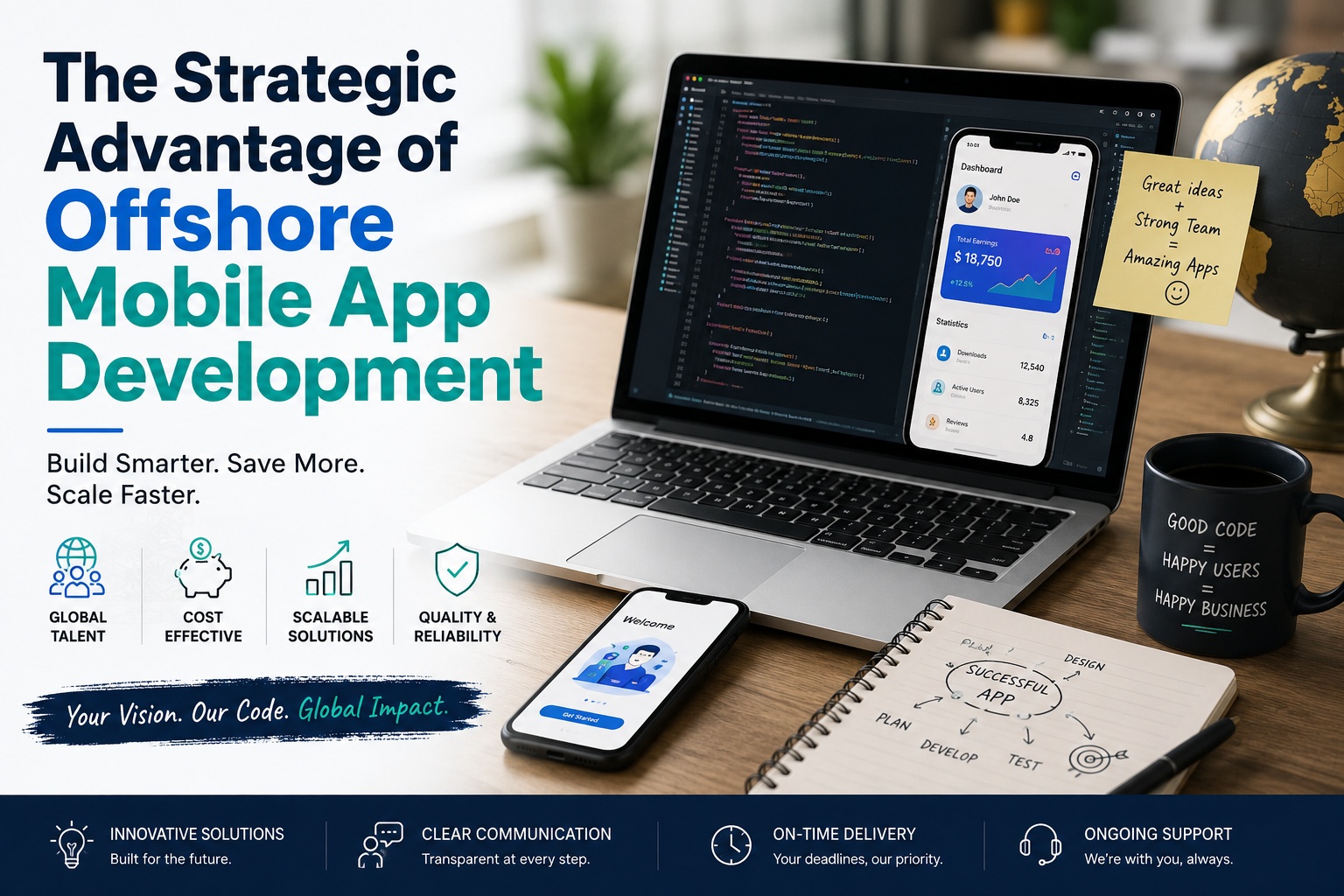
Building a mobile app sounds glamorous until the estimates arrive. Suddenly, that brilliant idea for a sleek customer portal, booking platform, service app, or e-commerce tool starts looking less like innovation and more like a second mortgage with push notifications.
That is why many businesses consider offshore mobile app development. Done well, it can give companies access to skilled developers, broader technical talent, and more flexible pricing. Done badly, it can turn into a very expensive group chat filled with missed deadlines, mystery invoices, and the phrase “almost finished” repeated for six months.
The good news is that offshore development is not automatically risky. It is also not automatically cheap magic. It is a business strategy. Like any strategy, it works best when you know what to ask, what to avoid, and when to run away before someone sends you a 47-page proposal with no actual timeline.
What Offshore Mobile App Development Actually Means
Offshore mobile app development means hiring a development team or agency in another country to design, build, test, or maintain a mobile application. That team may handle the entire project, or it may support your in-house staff with specific pieces such as user interface design, backend development, quality assurance, security testing, or ongoing maintenance.
For growing businesses, this can be especially appealing. Instead of hiring a full internal team, companies can work with outside specialists as needed. That flexibility matters when an app is important to the business but does not justify the cost of permanent developers, designers, testers, and project managers sitting on payroll year-round.
Google’s guidance on creating helpful digital content emphasizes making information useful, reliable, and people-first. That same mindset applies to app development. The best app is not the one with the flashiest feature list. It is the one that solves a real problem clearly and securely for the people using it. Google Search Central explains the importance of helpful, reliable, people-first content, and that principle is worth remembering before building any digital product.
Why Businesses Choose Offshore Development
The most obvious reason is cost. Offshore development can often be more affordable than building a full local team, especially for small and mid-sized businesses. Labor rates vary widely around the world, and companies may be able to access experienced developers at a lower overall project cost.
But cost should not be the only reason. In fact, if the entire decision comes down to “Who is cheapest?” the project may already be in trouble. The lowest bid can become the most expensive option once delays, bugs, rewrites, and emergency fixes are added. Nothing says “budget-friendly” quite like paying twice to repair something that should have been built properly the first time.
The stronger reason to consider offshore mobile app development is access. A good offshore team may bring experience in iOS, Android, progressive web apps, backend systems, payment integrations, artificial intelligence tools, automation, and user experience design. For a business that needs specialized skills quickly, that can be a major advantage.
For companies already investing in digital tools, this connects naturally with broader technology planning. Businesses that are updating their systems may also want to review practical technology upgrades, including smart infrastructure and connected platforms. For more on that larger shift, see Smart Home Technology That Actually Improves Daily Life.
The Real Benefits of Offshore Mobile App Development
Offshore development can work beautifully when expectations are clear from the beginning. The strongest benefits usually fall into a few key areas.
- Lower development costs: Businesses may reduce expenses compared with hiring a full internal team, especially for short-term or project-based work.
- Access to specialized talent: Offshore teams may have developers with experience in mobile apps, cloud platforms, AI tools, automation, and cybersecurity.
- Faster scaling: Companies can add designers, developers, or testers as project needs change.
- Round-the-clock progress: Time zone differences can help work continue outside normal local business hours, although this only helps if communication is managed properly.
- Ongoing maintenance: A development partner can help update the app after launch, fix bugs, improve performance, and add features over time.
The important phrase here is “managed properly.” Offshore development does not remove the need for leadership. Someone still needs to define the project, approve designs, test features, manage deadlines, and ask uncomfortable questions before the app launches with a button that leads absolutely nowhere.
Quality Should Not Be Negotiable
One of the biggest myths about offshore development is that lower cost automatically means lower quality. That is not always true. Many excellent development teams operate internationally. The problem is not location. The problem is weak vetting.
A serious offshore development partner should be able to explain their process clearly. They should show examples of previous work, describe how they test apps, outline who will be assigned to the project, and clarify how communication will be handled. If the proposal is vague, the timeline is fuzzy, or the answers sound like they were copied from a brochure written by a committee, that is your sign to slow down.
Ask about coding standards, documentation, testing, app store submission support, post-launch maintenance, and ownership of the final code. That last point matters. Your business should understand exactly who owns the app, the source code, the designs, the data, and the accounts connected to the project.
Security Has to Be Part of the Plan
Any mobile app that collects customer information, payment details, location data, health information, photos, messages, or account logins needs serious security planning. This is not the fun part of app development, but it is the part that keeps your business out of trouble.
The Federal Trade Commission advises app developers to think carefully about data minimization, access permissions, authentication, security by design, and how information is communicated to users. The FTC’s app developer security guidance is a useful resource for understanding why security needs to be built in from the start rather than sprinkled on later like parsley.
For more technical security planning, the National Institute of Standards and Technology provides a Secure Software Development Framework that outlines secure development practices. The Open Worldwide Application Security Project also maintains the Mobile Application Security Verification Standard, which is widely used for mobile app security requirements and testing.
In plain English: do not let anyone build your app without discussing security. A beautiful app that leaks customer data is not a beautiful app. It is a lawsuit wearing nice colors.
Communication Can Make or Break the Project
Offshore development usually involves different time zones, different working styles, and sometimes language differences. None of that has to be a problem. But it does mean communication needs structure.
Before hiring a team, ask how often you will receive updates, who your main contact will be, what tools they use for project management, and how revisions are handled. Weekly updates may be enough for some projects. Larger builds may need more frequent check-ins, shared task boards, design reviews, and milestone approvals.
Clear communication also means clear documentation. Every feature should be written down. Every deadline should be attached to a deliverable. Every payment milestone should correspond to completed work. This is not being difficult. This is being an adult with a budget.
What to Ask Before Hiring an Offshore App Development Team
Before choosing a development partner, businesses should ask practical questions. The answers will reveal whether the team is organized, experienced, and realistic.
- What mobile platforms do you specialize in?
- Will the app be native, hybrid, or a progressive web app?
- Who will manage the project day to day?
- How are timelines and milestones tracked?
- How do you handle app testing and bug fixes?
- What security standards do you follow?
- Who owns the code, designs, and final app assets?
- What happens after launch?
- How are maintenance, updates, and future changes billed?
These questions are not just technical. They are protective. They help prevent the classic app-development disaster where everyone is very excited in month one, confused in month three, and pretending not to see the invoice in month five.
When Offshore Development Makes the Most Sense
Offshore mobile app development can be a strong option for businesses that have a clear idea, defined goals, and a realistic budget. It works especially well when the company knows what the app needs to do and has someone available to review progress and make decisions.
It may be useful for customer service apps, booking systems, internal workflow tools, e-commerce platforms, smart home service tools, real estate apps, education platforms, and business automation projects. For companies thinking more broadly about technology and operations, related digital improvements can also support better efficiency. YHDC has covered this in The Art of Efficient Enterprise Shipping Solutions, which looks at how digital tools can improve business systems.
Offshore development may not be ideal if the project is vague, the budget is unrealistic, or the business owner does not have time to participate. No development team, no matter how talented, can read minds. If the project brief is “make it modern and amazing,” expect confusion. Possibly expensive confusion.
The Biggest Mistakes to Avoid
The first mistake is choosing based only on price. A cheap proposal can be tempting, but if it leaves out testing, maintenance, documentation, or security, the real cost may arrive later.
The second mistake is skipping the discovery phase. Before anyone starts building, the team should understand the audience, core features, user journey, technical requirements, and business goals. Without that foundation, the project can wander.
The third mistake is ignoring post-launch support. Apps are not finished the day they go live. Operating systems update. Users find bugs. Security needs change. Features need improvement. Launch day is not the finish line; it is the day the app starts behaving in public.
The fourth mistake is failing to protect access. Make sure your business controls important accounts, including app store accounts, hosting, analytics, domain names, payment processors, and administrative logins. You do not want your entire app held hostage by someone named “admin” in another time zone.
How to Make Offshore Mobile App Development Work
The best offshore projects usually have a few things in common. They start with a clear project scope. They include a realistic timeline. They define who is responsible for what. They use written milestones. They include testing before launch. They plan for maintenance after launch.
Most importantly, they treat the offshore team as a professional partner, not a bargain-bin shortcut. Good developers need clear direction, timely feedback, and enough information to make smart decisions. When the relationship is structured well, offshore mobile app development can help businesses create useful, polished digital tools without building an entire internal department from scratch.
The Bottom Line
Offshore mobile app development can be a smart way to build a mobile app more efficiently, but only when it is handled with discipline. The right partner can bring technical skill, flexible staffing, and cost advantages. The wrong partner can bring delays, confusion, security problems, and the kind of app that makes users delete it before finishing their coffee.
The goal is not simply to build an app. The goal is to build the right app: one that works, protects users, supports the business, and can grow over time. That requires planning, communication, security, and a development team that understands both the technology and the business purpose behind it.
In other words, offshore mobile app development can absolutely be a strategic advantage. Just make sure the strategy comes before the invoice.