


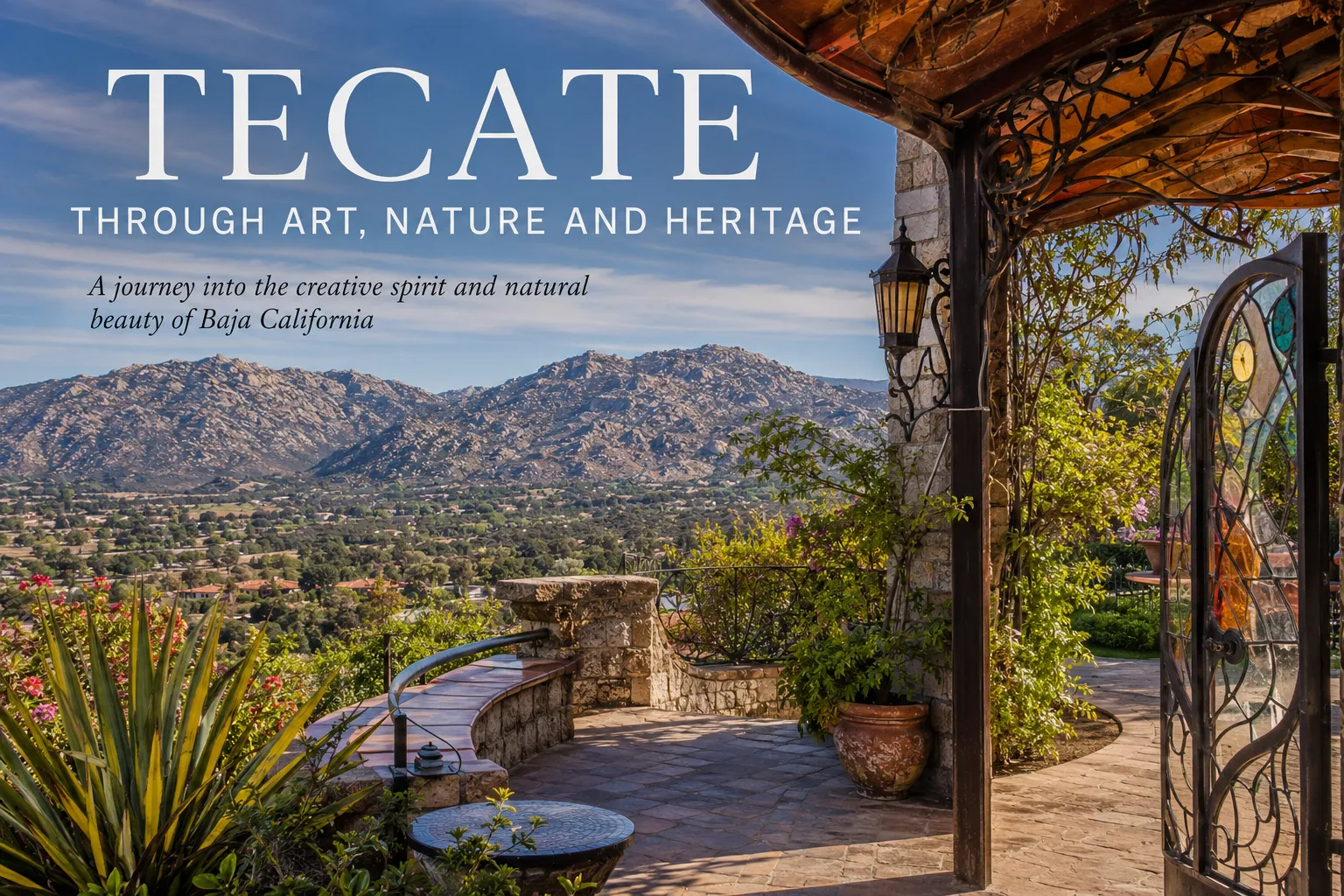
Tecate is easy to overlook.For many Southern Californians, this Baja California city is familiar mostly as a border crossing on the way deeper into Mexico.
But spend a little time here and Tecate begins to reveal something much more interesting: a place where art, architecture, indigenous history, gardens, wellness, and rugged northern Baja scenery are unusually intertwined.
Unlike destinations built around beach clubs or sprawling resorts, Tecate has a quieter appeal. Granite mountains rise beyond the city, handcrafted architectural details appear in unexpected places, and some of its most memorable spaces seem designed to belong to the landscape rather than dominate it.
That makes Tecate particularly interesting for anyone who pays attention to how places are built, furnished, planted, and lived in.
James Hubbell Left an Artistic Legacy in Tecate
One of the best ways to understand Tecate is through the work of the late artist and architectural designer James Hubbell.
Hubbell was known for an organic approach that blurred the boundaries between architecture, sculpture, stained glass, metalwork, wood, and landscape. His buildings rarely relied on perfectly straight lines or conventional symmetry. Instead, they curved, twisted, opened toward nature, and often looked as though they had evolved from their surroundings.
Northern Baja provided an especially appropriate setting for that philosophy. Hubbell’s work appears throughout the Tecate area, including at Rancho La Puerta and in projects connected to the region’s Kumeyaay heritage. The Ilan-Lael Foundation, which preserves and shares Hubbell’s artistic legacy, documents his extensive work in Baja California and his belief that art and architecture could bring communities together.
What makes his work memorable is not simply its beauty, but the way materials are treated. Stone looks like stone. Wood retains its grain. Metal bends rather than disappearing into perfectly manufactured lines. Colored glass changes throughout the day as sunlight moves across it.
That sense of craftsmanship gives Tecate a character that feels increasingly unusual in an era of identical finishes and mass-produced interiors.
Rancho La Puerta Makes the Landscape Part of the Design
Rancho La Puerta has been part of Tecate since 1940 and is best known as a wellness destination, but it is equally interesting as a study in landscape-driven design.
The property does not revolve around one enormous hotel building. Instead, accommodations, gardens, fitness spaces, gathering areas, and pathways are spread throughout the grounds beneath Mount Kuchumaa. Walking through the property becomes part of the experience.
Trees shade winding paths. Gardens soften stone walls. Casitas appear behind landscaping rather than sitting in rows. Courtyards, fountains, handcrafted doors, fireplaces, sculpture, and stained-glass details reveal themselves gradually.
Hubbell contributed numerous artistic elements to the ranch, and his work fits naturally into this setting because it does not feel applied afterward as decoration. It feels integrated.
There is an important home-design lesson in that distinction. A room does not necessarily become more beautiful because more objects are added to it. Sometimes a stronger result comes from better materials, better natural light, a meaningful piece of art, or a view that has been intentionally framed.
That same relationship between architecture and landscape can also be seen elsewhere in Baja. Our look at Loreto and the way design meets the natural environment shows how dramatically a home or resort can change when the surrounding landscape is treated as part of the architecture rather than scenery outside the window.
Mount Kuchumaa Is More Than a Beautiful Backdrop
Mount Kuchumaa dominates portions of the landscape around Tecate and Rancho La Puerta, but its importance extends well beyond its appearance.
The mountain holds deep cultural significance for the Kumeyaay people, whose traditional territory spans areas that today lie on both sides of the United States-Mexico border. Understanding that history changes the way a visitor sees the landscape.
The mountains, oak trees, native vegetation, rock formations, and open spaces surrounding Tecate are not simply picturesque elements waiting to be photographed. They are part of a much older cultural landscape.
That history also provides important context for Hubbell’s work in the area. His approach frequently emphasized collaboration, gathering places, and respect for the environment, qualities that helped shape projects created in and around the Tecate region.
Kuchumaa Passage Shows How Architecture Can Frame Nature
One of Hubbell’s particularly interesting projects in the area is Kuchumaa Passage at Rancho La Puerta.
Created as a gathering place overlooking Mount Kuchumaa, the structure demonstrates an idea that appears repeatedly in Hubbell’s work: architecture does not always need to be the most important thing in the view. Sometimes its job is to direct attention elsewhere.
The passage uses organic forms and materials to create a sheltered place from which visitors can experience the surrounding landscape. Instead of competing visually with the mountain, the structure helps frame it.
That principle translates remarkably well to residential design. A patio can be positioned around a favorite view. A pergola can frame a garden rather than overwhelm it. A window can be placed to capture a mature tree. Outdoor seating can be oriented toward the evening light rather than simply lined up against a wall.
Good design frequently comes down to deciding what deserves attention.
Kumeyaay Heritage Adds Meaning to the Region
Tecate’s story cannot be told properly without acknowledging Kumeyaay culture.
The Kumeyaay have lived throughout what is now San Diego County and northern Baja California for generations, long before an international border divided the region. Their history gives Tecate a cultural depth that is easy to miss when the city is treated only as a travel stop.
Museums and cultural sites in the area introduce visitors to indigenous history, archaeology, traditions, and the relationship between people and the surrounding environment.
For design-minded travelers, this history is also a useful reminder that materials and decorative ideas have context. Patterns, weaving, pottery, natural materials, artwork, and architectural forms become much more meaningful when their origins are understood rather than copied simply because they look attractive.
That idea connects closely with the way we think about meaningful interiors at home. In When Objects Become Home, we explored how objects, memory, culture, and personal history can give a space character that trend-driven decorating rarely achieves.
Tecate reinforces the same lesson on a much larger scale.
Tres Estrellas Turns a Farm Into Part of the Experience
Another side of Tecate’s relationship with the landscape appears at Tres Estrellas, Rancho La Puerta’s organic farm.
The farm grows vegetables, herbs, fruits, and flowers that support the property’s culinary programs, but it is more than a purely agricultural space. Rows of crops, orchards, raised planting areas, flowers, paths, and surrounding mountains demonstrate that productive landscapes do not need to look utilitarian.
That is an idea homeowners can borrow surprisingly easily. An attractive garden can include rosemary, lavender, citrus trees, herbs, peppers, tomatoes, or edible flowers alongside ornamental plants. Raised beds can become architectural features rather than something hidden behind the garage.
Even a small patio can combine attractive containers with herbs that actually make their way into dinner. The best outdoor spaces tend to work harder than they initially appear to.
Gardens and Architecture Work Together Here
One of the strongest impressions Tecate leaves is how often the landscaping feels inseparable from the architecture.
At Rancho La Puerta in particular, trees and plantings do more than decorate the property. They create shade, soften walls, guide movement, provide privacy, frame views, and make outdoor areas feel like rooms rather than leftover spaces between buildings.
That approach can make even a modest home feel more considered. A pathway does not necessarily need to run in the straightest possible line. Seating does not always belong directly against the house. A mature plant or tree can become the focal point around which an outdoor space is designed.
The same principle appears at well-designed coastal properties closer to home. Our feature on Alila Marea Beach Resort Encinitas examines how architecture, natural materials, landscape, and location can work together to create a stronger sense of place.
The climate is different, but the design principle is remarkably similar.
Handmade Details Give Tecate Its Personality
Modern homes can become so polished that they lose the little irregularities that make spaces memorable. Tecate provides a useful counterpoint.
Handcrafted ironwork, carved wood, stone, ceramics, glass, and other artisan elements bring texture and individuality to the built environment. The appeal is often in the imperfection.
A handmade tile may not match the one beside it precisely. Stone surfaces naturally vary. Ironwork can reveal the hand of the maker. Blown or stained glass changes as light moves through it. These materials tend to become more interesting with age rather than less.
That does not mean a home needs to become rustic. One handmade object can be more effective than a room full of deliberately “artisan” décor.
A sculptural light fixture, handmade ceramic vessel, carved bench, woven textile, or original piece of art can provide the contrast that keeps a clean contemporary room from feeling anonymous.
Tecate’s Food Is Closely Connected to the Land
The relationship between place and design extends to the table.
Northern Baja’s culinary reputation has grown enormously, but some of its most appealing meals remain surprisingly straightforward: fresh produce, regional cheeses, grilled meats, tortillas, herbs, vegetables, and ingredients that do not require much intervention to taste good.
At Rancho La Puerta, the connection between the garden and kitchen makes that relationship especially visible.
For anyone who enjoys entertaining at home, there is another lesson here. A memorable table does not require an elaborate menu or excessive styling.
Good ingredients, simple ceramics, linen, flowers or herbs from the garden, and an inviting place to sit can feel considerably more sophisticated than a dinner party trying to look expensive.
Wellness in Tecate Is About More Than a Spa
Tecate also offers a broader definition of wellness than the one often marketed through products.
Walking, gardens, hiking, sunlight, quiet places, outdoor exercise, fresh food, and mountain views are built into the experience. That concept can translate directly into home design.
A wellness-oriented home does not necessarily need a dedicated meditation room or expensive equipment. Natural light, fresh air, easy access to an outdoor area, a comfortable chair beside a window, or a garden that draws you outside can all make everyday life more pleasant.
Some of the most effective wellness improvements are simply thoughtful design decisions.
Tecate Is Better When You Do Not Rush It
Tecate is not a destination that needs to compete for attention. That may be one of its greatest advantages.
The city and surrounding countryside reward travelers who slow down enough to notice the details: a piece of stained glass catching the afternoon sun, an old stone wall, a garden path disappearing around a corner, a handcrafted gate, or a view toward Mount Kuchumaa.
There is no need to manufacture spectacle when the landscape is already doing most of the work.
That slower rhythm also makes Tecate a natural extension of a Baja road trip for travelers who enjoy architecture and regional character. Readers interested in this side of Mexico may also enjoy our feature on Casa Velas in Puerto Vallarta, where gardens, architecture, food, and a strong sense of place create a very different interpretation of Mexican hospitality.
What Tecate Can Teach Us About Home Design
The best travel stories eventually come back home, and Tecate offers plenty worth borrowing.
Use natural materials when possible rather than trying to imitate them. Choose one beautiful handcrafted object instead of filling a room with accessories. Allow landscaping to influence where patios, windows, and seating areas go. Think about how sunlight moves through a space throughout the day.
And do not assume luxury means adding more.
Some of Tecate’s most memorable places are compelling precisely because they show restraint. Architecture frames the mountains. Gardens soften buildings. Art appears where it has meaning. Handmade materials are allowed to look handmade. Nothing seems overly interested in proving how expensive it is.
That may be the most useful design lesson Tecate offers.
The spaces that stay with us are rarely the ones filled with the most things. They are the ones that feel connected to their surroundings, their history, and the people who actually use them.
