


A drafty house rarely announces itself with one obvious problem.
More often, it shows up in small, irritating ways. The hallway feels colder than the rest of the house. The sofa beside the window is suddenly the least desirable seat in the room. Your feet are cold even though the thermostat says the house is warm. One bedroom never quite catches up with the others, and the furnace seems to run longer than it used to.
That is usually when homeowners start asking, “Why is my house drafty?”
The instinct is often to blame the windows. Sometimes that is correct. But drafts are frequently more complicated than one bad window or one aging door. A house can lose heat through dozens of small openings that were never obvious in summer: a flattened strip of weatherstripping, a poorly sealed attic hatch, a gap around a pipe, a fireplace damper that no longer closes tightly, or an exterior-wall outlet that is letting more air through than anyone would expect.
The useful question is not simply where you feel cold air.
It is where the house is allowing air to move.
Start With the Room That Feels Wrong
You do not need special equipment to begin.
Start with the room that consistently feels colder than it should and pay attention to the pattern.
Is the cold concentrated along one wall? Does it seem strongest near the floor? Is the discomfort close to a window, a door, or a fireplace? Does the room feel fine until the wind picks up?
Those details help narrow the search.
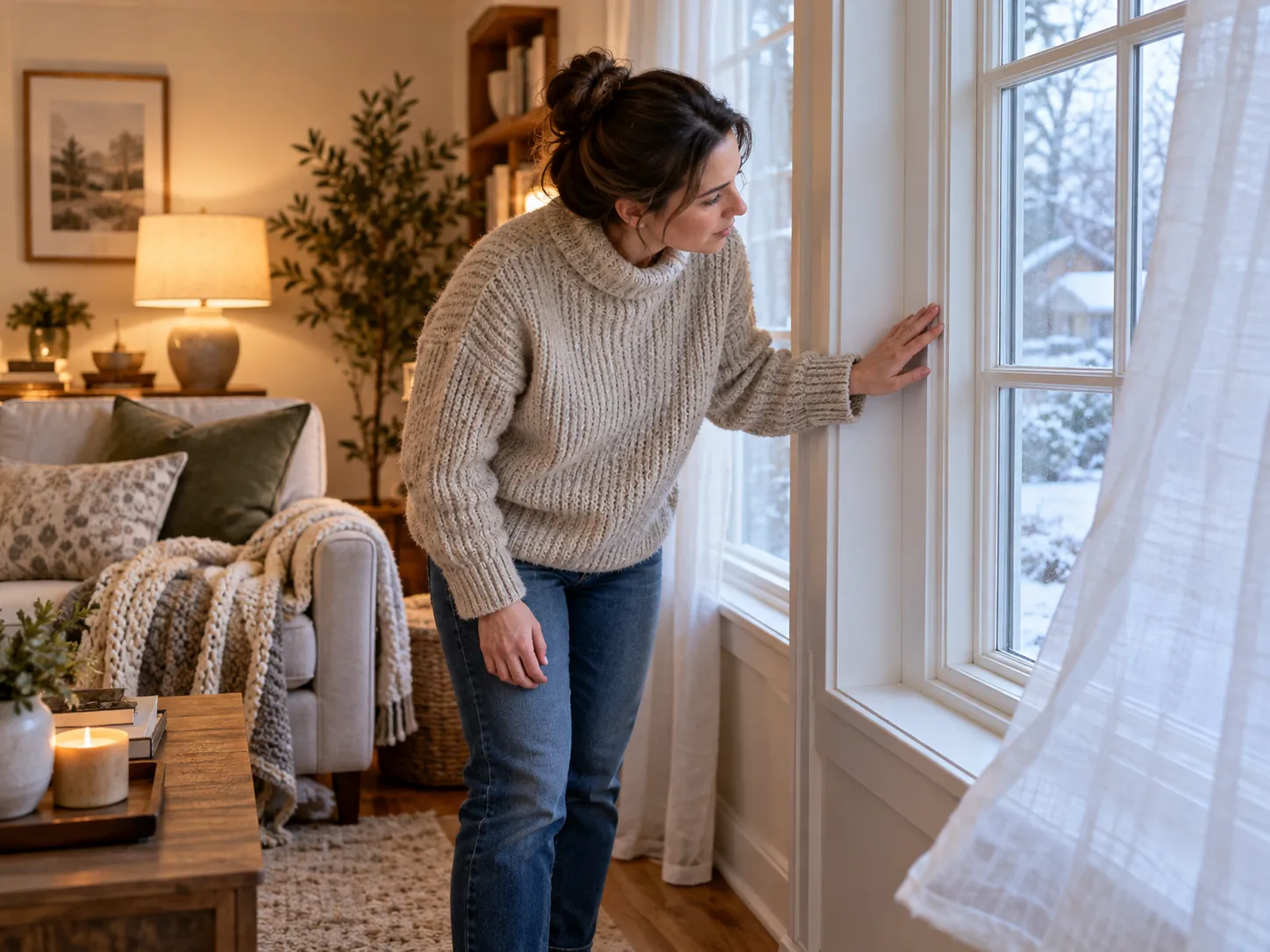
On a cool, breezy day, move slowly around the edges of windows and doors with your hand. Check the corners rather than only the middle of the frame. Run your hand along the bottom of exterior doors and around sliding-door tracks.
Then look beyond the obvious places.
ENERGY STAR notes that some of the largest household air leaks are not necessarily around the windows and doors where we feel them. They can be hidden around attic accesses, plumbing and wiring penetrations, recessed fixtures, basement rim joists, and other openings in the building envelope. Its guide to locating air leaks is a good reminder that the cold spot you notice may not be the actual source of the problem.
A draft near the sofa, for example, could come from a nearby window.
Or it could be cold air being pulled into the room because warm air is escaping somewhere above it.
That is why draft hunting works better as a process of elimination than as a race to buy a tube of caulk.
If You Can See Daylight, Start There
Some air leaks are wonderfully uncomplicated.
Close an exterior door and look around the perimeter. If you can see daylight between the door and frame, you have found at least part of the problem.
Weatherstripping is meant to compress when the door closes, creating a seal without preventing the door from moving. Over time, it can flatten, crack, peel away, or become too stiff to do its job.
The threshold and door sweep matter just as much.
A door can appear perfectly fine at eye level while allowing a ribbon of cold air across the floor because the sweep no longer reaches the threshold.
This is one of the easier DIY fixes in a drafty house because the failure is visible and the repair is usually straightforward.
YHDC’s guide to smart winter home upgrades that save energy without sacrificing style takes a broader look at the same idea: improving winter comfort often starts with the places where the house is already telling you something is not working efficiently.
Caulk Is Not the Answer to Every Gap
Caulk and weatherstripping are often mentioned together, but they solve different problems.
A useful way to remember the difference is this:
Caulk seals things that should not move. Weatherstripping seals things that do.
That means caulk belongs around stationary joints, such as a gap between window trim and a wall or certain small penetrations where building materials meet.
Weatherstripping belongs around operable windows and doors.
This sounds simple, but misuse is common. Homeowners sometimes caulk a moving joint, creating a temporary mess rather than a durable repair. Others keep adding weatherstripping to a door that is actually misaligned and no longer sitting squarely in the frame.
Before adding material, look at what has failed.
If the seal is worn, replace the seal.
If the frame has shifted, the door may need adjustment.
If the trim is pulling away from the wall, the problem is different again.
The Attic Hatch Can Behave Like an Open Window
One of the least glamorous parts of a house can be one of the most important.
Walk beneath an attic hatch in winter and you may notice a faint chill without immediately understanding why.
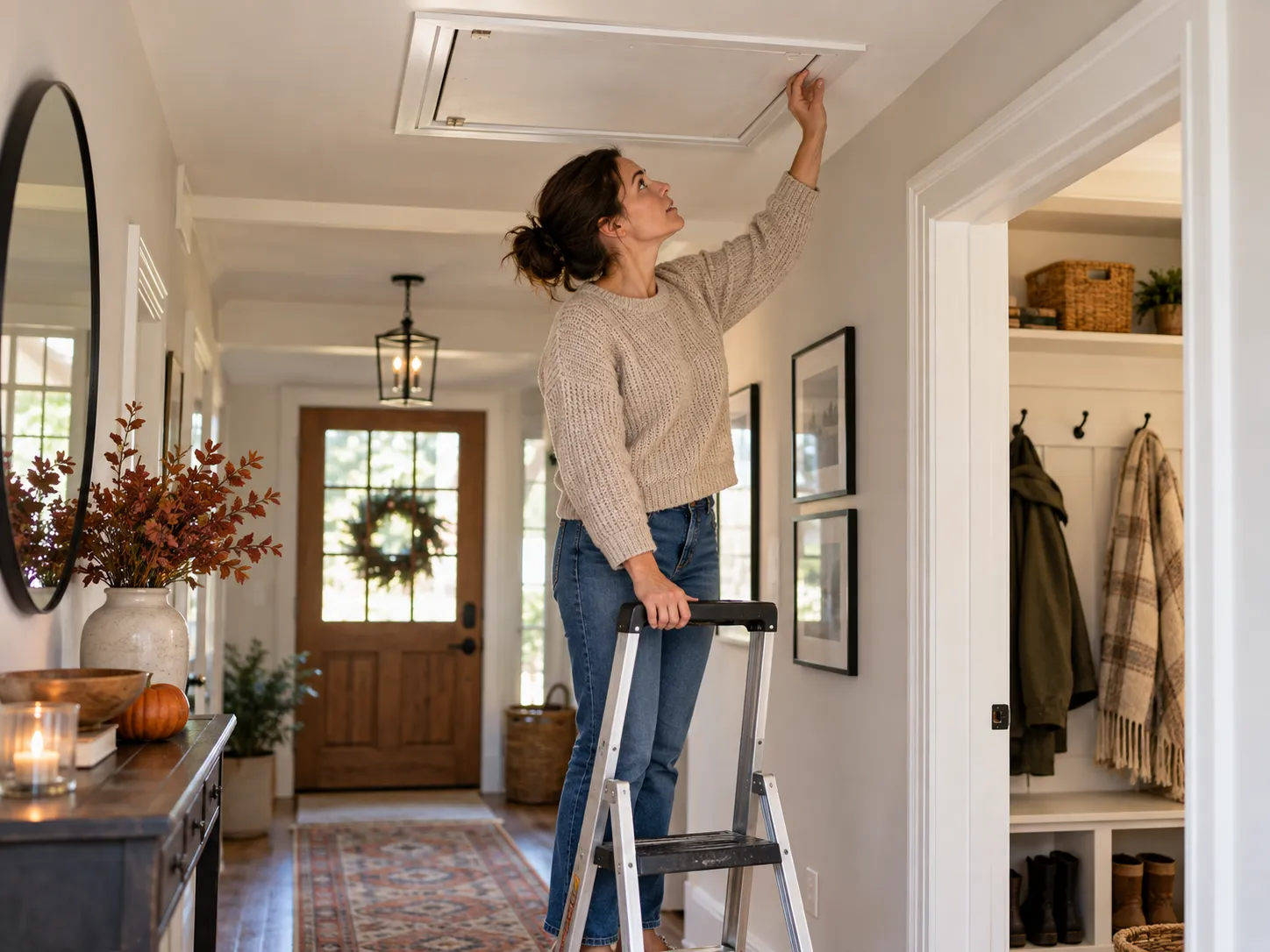
That panel separates heated living space from an unconditioned attic. If it fits loosely, lacks insulation, or has no effective seal around its edges, warm air can escape upward every time the house is heated.
Pull-down attic stairs create an even larger opening.
Look at the perimeter of the hatch. Does it sit flat? Is there a visible gap along one side? Does the panel feel significantly colder than the surrounding ceiling?
The attic itself can offer clues too. ENERGY STAR notes that darkened or dirty insulation can sometimes indicate air movement, because escaping air carries dust through the insulation.
That is the point where the issue begins to move beyond cosmetic comfort.
A badly leaking attic access is not just a cold spot. It can be part of a larger pattern of heat escaping through the top of the house.
That Cold Outlet May Not Be Your Imagination
Some draft sources are so small that they are easy to dismiss.
An electrical outlet on an exterior wall is one of them.
The outlet itself is not producing cold air, of course. The issue is that the electrical box creates an opening in the wall assembly. If the area around that box was not sealed well, air can move through the cavity and become noticeable around the cover plate.
Plumbing lines, cable penetrations, and utility openings can create similar pathways.
The temptation is to solve every tiny opening with expanding foam.
Resist it.
Sealing around wiring, electrical boxes, and heat-producing components requires appropriate materials and some understanding of what is behind the wall. When the opening is not clearly accessible and safe, this is a good place to stop DIY work rather than improvise.
Your Fireplace May Be Cooling the Room Even When No Fire Is Burning
A fireplace can be one of the coziest things in a house when it is in use and one of the draftiest when it is not.
Once the fireplace is completely cool, check whether the damper actually closes.
Older dampers can become warped, corroded, or coated with debris. Even a relatively small opening can allow warm indoor air to move up the chimney while colder air enters elsewhere to replace it.
You may not feel a dramatic blast of air directly at the fireplace.
Instead, the entire room can simply feel harder to keep comfortable.
Do not permanently block or seal a functioning fireplace simply to stop a draft. Fireplaces and other combustion appliances depend on proper ventilation, and any change that affects exhaust should be approached carefully.
The Garage Door Everyone Ignores
The front door gets attention because everyone sees it.
The door from the garage into the house often does not.
Yet in many homes, that door opens into a mudroom, hallway, kitchen, or laundry area that always seems colder in winter.
An attached garage may not be outdoors, but it can still become very cold. Worn weatherstripping around the connecting door can allow that cold air into the living space.
Close the door and look around its edges.
If you see daylight or feel a clear temperature difference along the frame, the seal deserves attention.
Just remember that garage-entry doors may have fire-rating or self-closing requirements. Do not remove or modify safety hardware in the name of stopping a draft.
Sometimes the Floor Is Telling You More Than the Window
A cold floor is easy to blame on the flooring material itself.
That is not always fair.
Cold air entering around a sliding door, threshold, or exterior wall tends to settle low in the room. The floor feels cold because the coldest air is sitting right above it.
In other homes, the problem is underneath: an uninsulated crawlspace, a cold basement, a concrete slab, or missing insulation between floor joists.
YHDC’s guide to keeping vinyl flooring warmer in winter explores that relationship in more detail.
The useful clue is scale.
If one small strip of floor near a door is cold, suspect an air leak.
If the entire floor is cold, start thinking about what is happening below it.
Drafty Home Checklist
Before turning up the thermostat, check:
- Exterior door weatherstripping
- Door sweeps and thresholds
- Window-frame and trim gaps
- Sliding-door tracks and seals
- Attic hatches and pull-down stairs
- Fireplace dampers
- Exterior-wall outlets
- Plumbing and utility penetrations
- Garage-entry door seals
- Cold floors, ceilings, and exterior walls
- Rooms that remain uncomfortable while the HVAC system is running
Several problems appearing together may indicate a larger insulation or air-distribution issue.
One of the Biggest Mistakes Is Sealing the Wrong Thing
A drafty house can make homeowners enthusiastic with sealant.
That enthusiasm needs limits.
Not every opening in a house is accidental.
Attics need ventilation. Combustion appliances need safe air and exhaust pathways. Some building assemblies rely on intentional drainage and airflow.
Blocking soffit vents because cold air is present in the attic, for example, is not an air-sealing solution. Those vents are there for a reason.
The same caution applies around furnaces, fireplaces, recessed fixtures, and wiring.
Another mistake is making the room feel better without repairing the cause.
Heavy curtains may reduce the sensation of cold near a window. A fabric snake at the bottom of a door may stop a noticeable draft.
Both can be useful.
Neither tells you why the leak exists.
If a window keeps needing caulk year after year, if trim is pulling away, or if moisture stains appear nearby, the problem deserves a closer look.
When the Problem Is Bigger Than a Draft
There is a point where small fixes stop making sense.
One door with failing weatherstripping is maintenance.
Three rooms that never reach the same temperature as the rest of the house suggest something else.
Pay attention when:
- One room is consistently colder than adjoining rooms.
- The furnace runs for long periods without improving comfort.
- Supply vents have noticeably weak airflow.
- Exterior walls or ceilings feel unusually cold.
- Large areas of flooring stay cold.
- Attic insulation looks thin, displaced, or damaged.
- Drafts return even after obvious gaps have been sealed.
- Moisture or staining appears around insulation or framing.
Those symptoms can point toward missing insulation, duct leakage, poor HVAC balancing, or larger leaks in the building envelope.
At that stage, more caulk becomes guesswork.
A professional energy assessment can be far more useful because it looks at the house as a system rather than treating every cold spot as a separate mystery.
Know When DIY Should Stop
Replacing worn weatherstripping is reasonable.
Sealing a small, clearly visible trim gap is reasonable.
Investigating damp insulation around a flue in a cramped attic is not the same kind of project.
Call a professional when the work involves difficult attic access, electrical components, mold or moisture damage, fireplace or furnace venting, suspected duct leakage, significant insulation deficiencies, or large temperature differences you cannot explain.
The point is not to avoid DIY work.
It is to use DIY where it actually makes sense.
The Your Home Design Center Take
A drafty house is often a house giving you clues.
The cold strip under the door, the attic hatch that never quite sits flat, the fireplace room that takes longer to warm, the outlet on the exterior wall that feels oddly cold — none of these details seems dramatic on its own.
Together, they can explain why a house feels less comfortable than the thermostat suggests.
Start with the simple failures you can see and feel. Repair worn seals. Close obvious gaps. Pay attention to where the cold is concentrated.
Then notice what does not improve.
Because when a house still feels drafty after the obvious leaks are fixed, the next question is no longer where to put more weatherstripping.
It is what the house is telling you about its insulation, airflow, and the spaces you cannot easily see.
