


The best home technology does not necessarily give homeowners more to control. Sometimes, its greatest advantage is quietly removing a repetitive job from the daily list.
You notice the crumbs beneath the dining table. Pet hair has collected along the hallway. Someone tracked dirt through the entryway. The kitchen floor could use another pass.
None of these jobs is particularly difficult. The problem is that they keep coming back.
That is where smart home cleaning is becoming genuinely useful. Instead of simply adding another connected gadget, newer autonomous cleaners are designed to handle routine floor care with less prompting, less setup, and less intervention between cleaning cycles.
For most homeowners, that is the realistic promise: a robot cleaner will not eliminate housecleaning, but a capable one can reduce how often you have to think about the floors.
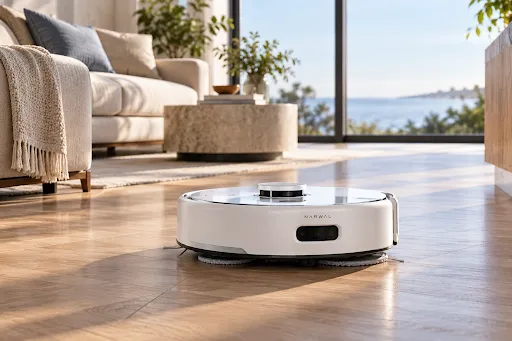
The Narwal Freo 20 Edge is a good example of that shift. It combines vacuuming, fresh-water mopping, automated navigation, obstacle detection, edge cleaning, and a dock that handles several of the messier maintenance steps after the robot returns.
The technology is impressive. More important, however, is whether those features make a real home easier to maintain.
Floor Cleaning Takes More Than the Time Spent Vacuuming
We tend to measure cleaning in minutes.
Twenty minutes to vacuum. Another ten to mop the kitchen. A quick pass through the entryway because the dog brought half the yard inside.
But household maintenance also involves noticing what needs attention, remembering it, deciding when to deal with it, and making sure it eventually happens.
Researchers describe some of this behind-the-scenes planning and monitoring as cognitive household labor. Peer-reviewed research on cognitive household labor has examined how that less-visible workload can contribute to stress when it becomes uneven or excessive.
The physical workload is significant too. According to the U.S. Bureau of Labor Statistics’ American Time Use Survey, 80% of Americans engaged in household activities on an average day in 2024, spending about two hours on them.
A robot vacuum obviously will not return those two hours by itself.
What it can do is take one predictable, recurring task and move it closer to automatic.
That is a much more useful way to think about home automation.
Who Benefits Most From an Autonomous Robot Cleaner?

Robot cleaning makes the most sense in homes where floors become dirty frequently rather than occasionally.
Pet owners are an obvious example. Hair, litter, food crumbs, dirt, and muddy paw prints can make floor cleaning feel continuous. Families with children often have the same problem, only with cereal involved.
Busy professionals, large households, and anyone with heavily used kitchens, hallways, living areas, and entryways can also benefit from automated maintenance cleaning.
YHDC’s guide to choosing the best vacuum cleaners for a cleaner, easier home points out that kitchens, entryways, living rooms, and hallways generally need more frequent attention than lower-traffic spaces.
Those are precisely the areas where scheduled robot cleaning can be useful.
Instead of waiting until the entire house needs vacuuming, homeowners can have frequently used areas cleaned more regularly and save manual cleaning for deeper or more complicated jobs.
How the Narwal Freo 20 Edge Handles Routine Cleaning
The original appeal of the robot vacuum was simple: it could travel around a room picking up dirt while you did something else.
The Freo 20 Edge takes that concept further by automating more of the work surrounding the cleaning itself.
Narwal rates the robot at up to 31,000 Pa of suction in Max Mode, allowing it to pick up everyday dust, crumbs, debris, and pet hair across hard floors and carpets.
Its DualFlow Tangle-Free System is designed to reduce hair wrapping around the cleaning brushes, an especially practical feature in homes with shedding pets or people with long hair.
Mopping is handled through Narwal’s FlowWash Mopping System. Rather than repeatedly dragging the same wet pad across the floor, the track-style mop is continuously rinsed with fresh water while the robot cleans.
The system uses 16 spray nozzles to refresh the mop, applies 12N of downward pressure, scrapes away residue, and extracts dirty water during the cleaning process.
For edges and corners, the EdgeReach system extends the mop outward to improve coverage close to walls.
Navigation combines rear-mounted dToF LiDAR mapping with 3D structured-light obstacle detection, allowing the robot to build cleaning routes while navigating around common objects in the home.
All of that matters because successful smart home cleaning depends on the machine being able to perform routine work without requiring someone to repeatedly rescue, reposition, or redirect it.
Mixed Flooring Requires Smart Setup
Most homes do not have one continuous flooring material.
You may have tile in the kitchen, hardwood through the living areas, carpet in the bedrooms, and area rugs connecting everything in between.
The Freo 20 Edge is designed to clean both hard surfaces and carpet. Narwal specifies several carpet modes along with automatic mop lifting of up to 12 mm when appropriate.
That makes mixed-floor homes a natural use case, but homeowners should still spend time configuring the system correctly.
Water-sensitive hardwood, delicate natural materials, specialty flooring, and certain rugs may have specific cleaning requirements. Always follow the flooring or rug manufacturer’s care instructions rather than assuming every surface should be wet-cleaned.
No-mop zones and room-specific settings can help keep the robot away from surfaces that need different treatment.
The goal is not to make every room follow one cleaning routine.
It is to automate the right routine for each part of the home.
Your Home Still Needs to Be Robot-Ready
Modern obstacle detection is considerably better than it was in the early days of robot vacuums, but it does not make everyday clutter irrelevant.
Loose charging cables, socks, small toys, lightweight fabrics, rug tassels, and other objects can still interfere with cleaning or prevent the robot from reaching part of the floor.
Before relying heavily on scheduled cleaning, spend some time making the main routes through the home easier for the robot to navigate.
Keep frequently cleaned areas reasonably clear. Secure troublesome cords. Give the dock an unobstructed approach. Watch lightweight rugs during the first few cycles. Use virtual boundaries or no-go zones where they make sense.
This is also why practical technology tends to work better than technology for its own sake.
As YHDC has explored in its guide to smart home technology that actually improves daily living, connected devices are most worthwhile when they solve recurring household problems instead of simply adding another app or feature to manage.
A robot cleaner should make the cleaning routine simpler, not create a new hobby.
The Dock Reduces Maintenance, but Does Not Eliminate It
 This is where realistic expectations matter.
The Freo 20 Edge’s all-in-one dock automatically empties collected dust, washes the mop, dries it with 113°F/45°C warm air, and provides self-cleaning functions for the dock and dirty-water system.
Narwal also advertises up to 120 days of dust storage in the base station under its specified testing and usage conditions.
Those features can reduce the amount of attention required after each cleaning run, but the system is not maintenance-free.
Homeowners still need to refill clean water and empty dirty water as required. The dust bag eventually needs replacing. Filters, brushes, sensors, the mop system, and dock should be checked and maintained according to Narwal’s instructions.
Homes with several pets or unusually heavy debris will naturally need more frequent attention.
That is an important distinction when evaluating any self-maintaining appliance.
Automation can greatly reduce routine maintenance without making maintenance disappear.
What a Robot Cleaner Can—and Cannot—Replace
The strongest use case for an autonomous cleaner is maintenance cleaning.
It can regularly pick up dust, crumbs, pet hair, tracked-in debris, and everyday floor grime before those small messes build up.
What it cannot do is replace every type of household cleaning.
Stairs still need attention. Baseboards collect dust. Upholstered furniture needs vacuuming. Difficult corners, spaces behind certain furniture, unusual spills, and detailed deep-cleaning jobs still require human intervention.
A conventional or handheld vacuum may therefore remain useful for stairs, furniture, vehicles, upholstery, and targeted messes.
The YHDC guide to essential home cleaning products is a good reminder that keeping a home clean typically requires several different tools because no single machine handles every surface and every type of mess equally well.
Rather than viewing the robot vacuum as a replacement for the entire cleaning closet, think of it as the appliance responsible for one very repetitive category of work.
The robot handles routine floors.
You handle the jobs that require reach, judgment, detail, or a pair of hands.
That division of labor is far more realistic—and ultimately more useful.
Smart Home Cleaning Works Best on a Schedule

One of the biggest benefits of automation is consistency.
Instead of waiting until the entire house looks dirty, homeowners can schedule cleaning around the way the household actually operates.
The kitchen and dining area might run after dinner.
Entryways may need extra passes during rainy weather.
Pet-heavy rooms can be cleaned more frequently during shedding season.
Living areas can run while everyone is at work or school.
Bedrooms may need less frequent attention than the busiest parts of the house.
This is where smart home cleaning becomes more than simply pressing a button from an app.
The homeowner decides what needs to happen once, creates an appropriate routine, and then allows the system to repeat much of it automatically.
You remain in control without needing to personally initiate every cleaning session.
The Your Home Design Center Take
The Narwal Freo 20 Edge will not make housecleaning disappear, and that should not be the standard by which any robot cleaner is judged.
Its more realistic value is taking responsibility for one repetitive part of everyday home maintenance.
For households with pets, children, busy schedules, mixed flooring, or heavily used living spaces, regular autonomous vacuuming and mopping can help prevent everyday debris from becoming another major weekend cleaning job.
There is still preparation. There is still maintenance. There are still stairs, furniture, corners, spills, and deeper cleaning jobs that need a person.
But the floors may require your attention far less often.
And that is where smart-home technology becomes genuinely useful.
The best connected home is not necessarily the one with the most gadgets.
It is the one where technology quietly takes care of the predictable work so the people living there do not have to keep remembering it.
